
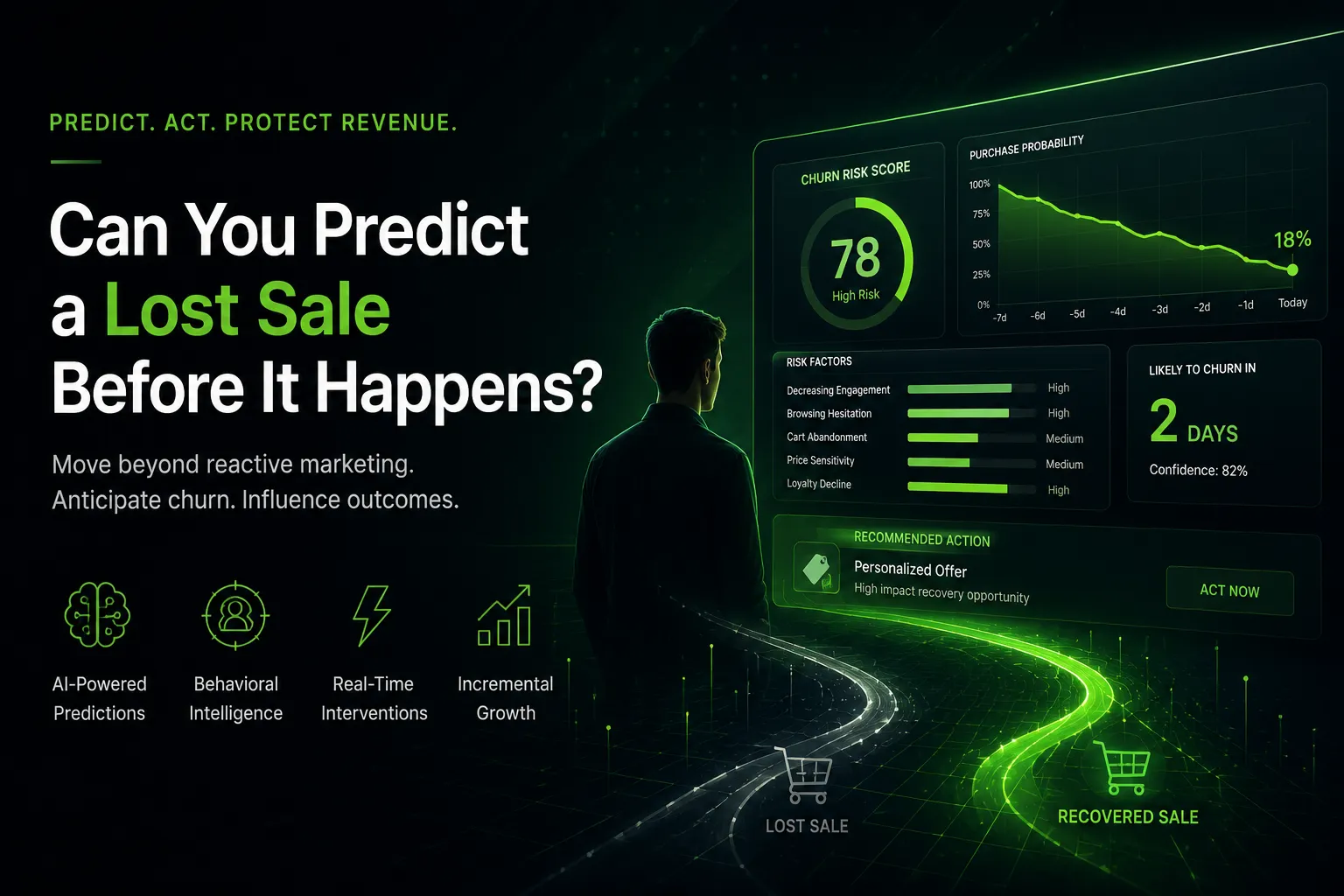
Can You Predict a Lost Sale Before It Happens?
A visitor lands on a product page, scrolls twice, opens the size chart, closes it, opens it again, then leaves the tab open for eleven minutes without moving the cursor. Nothing about that sequence trips an alarm anywhere in the store's software stack. No cart was abandoned. No email needs to be triggered. No exit-intent popup fires, because the mouse never approaches the top of the browser window. By every conventional measure, nothing happened.
Something happened. A lost sale just occurred, quietly, and almost nothing in most ecommerce technology stacks was built to notice it.
This article is about that gap — the space between the moment a customer's intent actually shifts and the moment a piece of software finally registers that something is wrong. Closing that gap is one of the more interesting problems in ecommerce right now, and it starts by admitting that most of what gets called "customer intelligence" today is really just record-keeping with a dashboard on top.
Why Most Ecommerce Platforms React Too Late
Walk through the standard toolkit of a mid-market ecommerce brand. Abandoned cart emails fire after a cart sits idle for an hour. Exit-intent popups fire when a cursor moves toward the browser's close button. Win-back campaigns fire after thirty or sixty days of inactivity. Every one of these mechanisms shares the same structure: wait for a visible, explicit signal, then respond to it.
The trouble is that by the time any of these signals fire, the customer's decision is usually already made. The cart wasn't abandoned in the moment it was left idle — it was abandoned mentally several steps earlier, when hesitation first crept in. The software is reacting to the funeral, not the illness.
Why Exit Intent Is Already a Late Signal
Exit intent technology detects cursor movement toward the top of a browser window and assumes that motion means a visitor is about to leave. It's a clever piece of engineering for what it is, but it measures a physical action, not a mental one. By the time a hand moves toward the close button, the decision to leave has typically already been made seconds or minutes earlier — during a moment of hesitation, a comparison to a competitor's price in another tab, or simply fading interest that built up gradually.
Treating cursor movement as the moment of churn is a bit like treating the moment someone stands up from a restaurant table as the moment they decided the meal wasn't worth finishing. The standing up is just the last visible act in a decision that started much earlier.
Why Abandoned Carts Are Symptoms, Not Causes
Cart abandonment gets treated as the central problem in ecommerce retention, and entire product categories exist to "recover" it. But an abandoned cart is a symptom of something that already happened upstream — indecision about sizing, a shipping cost that surprised the shopper at checkout, a comparison to another store, a distraction that pulled attention away entirely. The cart itself didn't cause anything. It's evidence of a decision process that had already started drifting away from purchase.
Recovering an abandoned cart is useful. But it's a bit like treating a symptom after the underlying condition has already progressed. The more valuable question is what happened in the minutes before the cart was left, because that's where the actual cause lives.
Why Opened Email Is Not Prediction
Email open rates get treated as a proxy for interest, and click-through gets treated as a proxy for intent. Both are useful engagement metrics. Neither is prediction. An opened email tells you a subject line was compelling enough to earn a glance. It doesn't tell you whether the recipient is closer to buying or simply curious, bored, or clearing a crowded inbox.
Treating email engagement as a purchase signal conflates attention with intent, and the two diverge more often than marketing teams like to admit.
Why Inactivity Is Not Prediction Either
On the opposite end, many systems treat a period of inactivity — thirty days without a visit, sixty days without a purchase — as the trigger for a win-back campaign. This is detection after the fact, not prediction. By the time inactivity is measurable, the customer has usually already mentally moved on. The signal arrives so late that the campaign responding to it is closer to an autopsy than an intervention.
What Customer Churn Really Means
Customer churn is usually defined as the point when a customer stops buying. That definition is technically correct and practically useless, because it describes an outcome rather than a process. Churn isn't an event that happens on a specific Tuesday. It's the endpoint of a gradual erosion of interest, trust, or convenience that started well before the last purchase and continued quietly, unnoticed by any dashboard, until the relationship was effectively over.
Defining churn as an event is why most churn-response systems are structurally late. They're built to detect an ending, not a slide.
The Difference Between Churn Detection and Churn Prediction
Churn detection looks backward. It identifies customers who have already stopped engaging, based on a threshold — no purchase in ninety days, no site visit in sixty. Churn prediction looks forward. It attempts to estimate, while a customer is still active, whether their behavior pattern resembles the patterns of people who are about to leave.
The difference sounds subtle but changes everything about what a business can do in response. Detection only allows for recovery attempts after the relationship has already cooled. Prediction allows for intervention while the relationship is still warm enough to save without much effort.
Why Every Customer Gives Small Behavioral Clues Before Leaving
Almost nobody churns instantly. Even impulsive purchase decisions and impulsive departures tend to be preceded by small, easy-to-miss signals scattered across a session or across several sessions. None of these signals is dramatic on its own. Collectively, they tell a story.
Micro Behaviors
Micro behaviors are the small, low-signal actions that rarely get logged meaningfully: hovering over a price without clicking, scrolling past a product and returning to it, opening a review section and closing it quickly. Individually, each of these is nearly meaningless. In sequence, across a session, they start to describe a state of mind.
Decision Fatigue
Decision fatigue shows up as slowing engagement over the course of a session — more time between clicks, more scrolling without action, a widening gap between browsing and deciding. It's a well-documented phenomenon in behavioral psychology broadly, and its retail equivalent is a shopper who is technically still on the page but has stopped making forward progress.
Browsing Hesitation
Hesitation shows up as repeated returns to the same product, the same size selector, or the same shipping information without ever completing the action. It's different from simple interest — interest tends to move forward through a journey, while hesitation tends to loop.
Repeated Product Comparisons
A shopper who opens three similar products, switches between browser tabs, and returns to the store repeatedly without buying is signaling something specific: they haven't yet resolved which option is right for them, or whether this store is the right place to buy it at all. That's a very different mental state from someone who is simply browsing casually.
Attention Decay
Attention decay refers to the gradual reduction in engagement depth over a session or across visits — shorter time on page, fewer scroll events, less interaction with content that previously drew engagement. It's one of the more reliable early signals that interest is fading, well before any explicit exit action occurs.
Intent Shifts
Perhaps the most important category: intent shifts, where a visitor's behavior changes direction mid-session — moving from product pages toward the help center, from checkout back toward the homepage, from a specific SKU toward broad category browsing. These reversals often mark the moment a purchase decision quietly falls apart.
Why No Single Event Predicts Churn
It's tempting to look for the one signal that reliably predicts a lost sale — the smoking gun event that, if detected, would let a business intervene with confidence. It doesn't exist, and the search for it is largely a dead end. Any single behavior, taken alone, is ambiguous. A long pause on a page could mean hesitation or could mean the visitor stepped away to answer the phone. A closed tab could mean abandonment or could mean the customer intends to finish the purchase on their laptop later that evening.
Certainty doesn't come from any one event. It comes from the accumulation of many weak signals pointing in the same direction.
Why Patterns Matter More Than Events
This is the conceptual core of predictive customer intelligence: patterns matter more than events. A single hesitant pause means little. A pause, followed by a repeated product comparison, followed by attention decay, followed by an intent shift away from checkout — that sequence, taken together, starts to resemble the behavioral signature of a shopper who is drifting away from a purchase, even if no single step in that sequence would raise a flag on its own.
Behavioral Sequences
A behavioral sequence is the order and timing in which actions occur, not just which actions occurred. The same three actions — viewing a size chart, opening reviews, leaving the page — mean something different depending on whether they happened in ninety seconds or across three separate visits over a week. Sequence carries information that a simple tally of events discards.
Customer Context
The same behavior can mean opposite things depending on who is doing it. A first-time visitor comparing three products is doing normal research. A loyal repeat customer suddenly comparing three products, after years of going straight to their usual item, is showing a meaningful deviation from their own baseline. Customer context — a person's own history — often matters more than the raw behavior itself.
The Importance of Combining Many Weak Signals
Individually weak signals become considerably stronger when combined, provided they're combined thoughtfully rather than just added up. This is a familiar idea outside ecommerce — a single symptom rarely diagnoses a condition, but a cluster of symptoms, considered together, often does. The same logic applies to behavioral data: attention decay alone is weak evidence, hesitation alone is weak evidence, but attention decay plus hesitation plus an intent shift, occurring within the same session, is considerably more informative than any of the three in isolation.
The Difference Between Analytics and Intelligence
Analytics describes what happened. Conversion rate last week, revenue by channel last month, bounce rate on the homepage yesterday — all backward-looking, all useful for understanding history. Customer intelligence, by contrast, is forward-looking. It takes the same underlying behavioral data and asks a different question: given everything observed so far, what is likely to happen next?
Most ecommerce software is built almost entirely on the analytics side of that line. Dashboards are extremely good at telling a merchant what already occurred. They are far less equipped to tell a merchant what's about to occur, because that requires a fundamentally different kind of modeling — one built around probability and pattern recognition rather than counting and summarizing.
Why Dashboards Explain the Past
A dashboard showing yesterday's conversion rate, last week's cart abandonment percentage, or last month's churned customer count is describing history accurately. It is not, by design, telling anyone what's happening right now inside a session that's still in progress. That's not a flaw in the dashboard — it's simply outside the category of problem dashboards were built to solve.
Why Predictive Systems Estimate the Future
A predictive system takes the same raw behavioral inputs — pauses, comparisons, sequence, context — and instead of summarizing them into a historical report, uses them to estimate a probability: how likely is this specific visitor, right now, to complete a purchase, and how likely are they to leave without one. That estimate can update continuously as new behavior arrives during the same session, which is a meaningfully different capability than a report that refreshes once a day.
How Prediction Changes Marketing Timing
The most practical consequence of prediction over detection is timing. A system that only reacts to an abandoned cart can only intervene after abandonment has already occurred, typically with a fairly blunt instrument — a discount code, an urgency banner, a reminder email. A system that can estimate rising hesitation while a shopper is still on the page has the option to intervene earlier, more gently, and often more effectively, because the customer hasn't fully disengaged yet.
Why Earlier Interventions Are Less Aggressive
There's a useful inverse relationship worth sitting with: the earlier an intervention happens, the smaller it usually needs to be. A shopper who is mildly hesitant might just need a clarifying detail — a size guide, a shipping estimate, a bit of reassurance about returns. A shopper who has fully disengaged and left the site often needs a much larger incentive to come back at all, if they come back. Waiting for a strong signal before acting tends to force a business into using stronger, costlier tools to recover attention that could have been kept for less.
Why Discounts Shouldn't Be the Default Solution
Discounting has become the default reflex for almost every re-engagement scenario in ecommerce, largely because it's easy to implement and its short-term effect is easy to see. But a discount offered to someone who was already going to buy is pure margin loss. A discount offered to someone who was never going to buy regardless of price rarely changes the outcome. The only scenario where a discount clearly earns its cost is the narrower one: a shopper who was on the fence specifically because of price, and only that shopper.
Prediction helps narrow that group. Instead of applying a blanket discount to every abandoned cart, a business that can estimate the specific reason behind hesitation — price sensitivity versus indecision versus distraction — can match the intervention to the actual cause, rather than defaulting to the most expensive tool available for every situation.
How Prediction Protects Profit Margins
Every discount handed to a customer who would have purchased at full price is a small, invisible tax on margin that never shows up as a line item anywhere obvious. Multiplied across thousands of transactions, it becomes one of the larger hidden costs in ecommerce retention strategy. Reducing reliance on blanket discounting, by identifying earlier and more precisely who actually needs an incentive, protects margin in a way that's easy to underestimate until it's measured directly.
Why Predicting One Lost Sale Is More Valuable Than Recovering One Abandoned Cart
These sound similar but aren't. Recovering an abandoned cart addresses a single, already-occurred event, usually through a discount. Predicting a lost sale earlier — while the customer is still engaged — opens the door to a broader set of responses, most of which don't require giving away margin at all: a clarifying message, a better-timed piece of content, a small nudge that resolves the actual source of hesitation. The earlier the intervention point, the more options exist, and the cheaper each option tends to be.
Privacy-Safe Prediction
None of this requires knowing more about a customer's identity — it requires understanding behavior better within a single session or across a customer's own history with a store. Privacy-safe prediction relies on first-party behavioral signals that a merchant already legitimately collects — pacing, sequence, interaction depth — rather than third-party tracking or identity resolution across the web. As privacy regulation tightens and third-party tracking continues to erode, this distinction matters more, not less: prediction built on a store's own first-party behavioral data is far more durable than prediction built on tracking infrastructure that's steadily being dismantled.
The Future of Ecommerce Customer Understanding
The broader trajectory here mirrors what happened in other parts of software over the past decade — a shift from static reporting toward continuous estimation. Fraud detection moved this direction years ago, from rule-based flags toward continuous risk scoring. Recommendation systems moved this direction, from static "customers also bought" lists toward continuously updated relevance scores. Customer retention in ecommerce is following the same path, just somewhat later.
Some modern ecommerce intelligence platforms are beginning to estimate purchase probability and churn risk continuously throughout a customer's journey, rather than waiting for an explicit exit signal like cart abandonment or a cursor moving toward the close button. Peloran is one of the platforms building in this direction — treating purchase intent as something that shifts gradually and can be estimated from the combination of many ordinary behavioral signals, rather than something that only becomes visible at the moment a customer is already leaving.
The goal isn't to react faster to the same late signals everyone else reacts to. It's to notice the shift in intent earlier than the shift becomes obvious — early enough that the right response is often small, cheap, and quiet, rather than a discount thrown at a customer who has already mentally checked out.
Frequently Asked Questions
What is the difference between churn detection and churn prediction?
Detection identifies customers who have already stopped engaging, based on a fixed threshold of inactivity. Prediction estimates, while a customer is still active, how likely they are to disengage soon, based on patterns in their behavior.
Is exit intent technology the same as churn prediction?
No. Exit intent detects a physical cursor movement toward the browser's close button. It reacts to a decision that has usually already been made, rather than predicting the decision before it happens.
Can a single behavior reliably predict that a customer will leave?
Generally not. Individual behaviors are ambiguous on their own. Reliable prediction comes from combining multiple weak signals — pacing, hesitation, comparison behavior, and shifts in intent — observed together.
Does predictive customer intelligence require more personal data than standard analytics?
Not necessarily. Much of the signal comes from first-party behavioral patterns a store already collects, such as browsing sequence and interaction pacing, rather than additional identity or tracking data.
Why shouldn't discounts be the default response to hesitation?
Because discounts only help the narrow group of customers who were hesitating specifically due to price. For everyone else, a discount either has no effect on the outcome or simply reduces margin on a sale that would have happened anyway.
Closing Thought
Most ecommerce software was built to answer a simple question well after the fact: what did the customer do? The more useful question, and the harder one, is what the customer is about to do — and whether there's still time, while they're still engaged, to change the outcome. That question can't be answered by waiting for a cart to sit idle or a cursor to drift toward the corner of a screen. It requires paying attention to the small, quiet signals that show up long before either of those things happens, and taking them seriously enough to act on before the moment has already passed.