
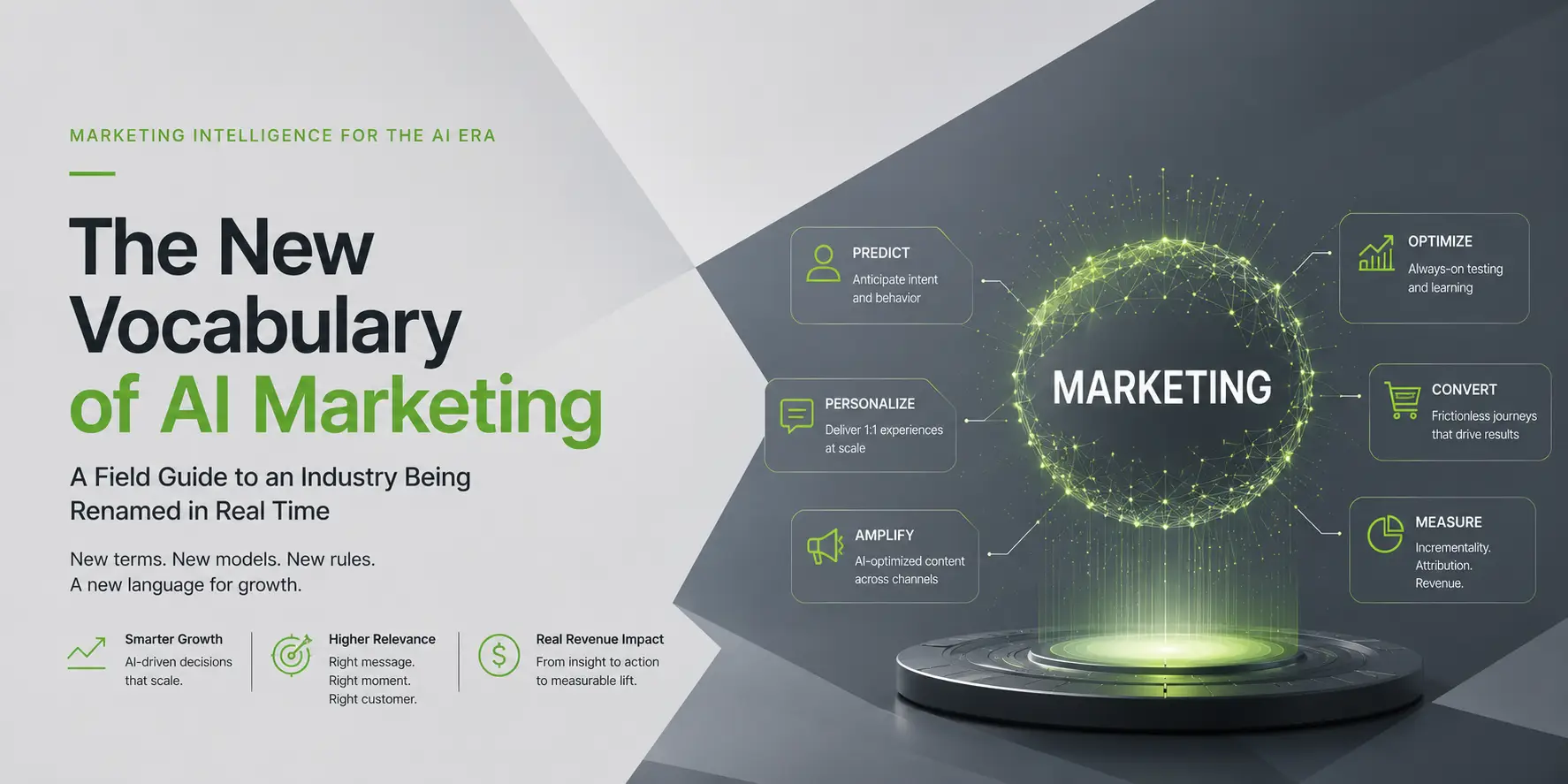
The New Vocabulary of AI Marketing: A Field Guide to an Industry Being Renamed in Real Time
Marketing has survived plenty of technology waves without changing its language. Email didn't retire the word "campaign." Programmatic didn't retire "audience." Marketing automation, for all its complexity, still ran on funnels, segments, and personas — the same nouns a brand manager would have recognized in 1995.
That continuity is now breaking. In the space of about two years, the working vocabulary of marketing has started shifting under practitioners' feet faster than the discipline itself has changed. Teams are being asked to reason about Agentic Marketing, Revenue Intelligence, GEO, and Hyperpersonalization before most of them have finished digesting what "marketing automation" was actually supposed to do.
Here is the claim this article will defend: marketing is not accumulating new terminology the way it has in past cycles. It is replacing its own operating vocabulary, and the replacement is happening because the underlying operating model — how decisions get made, who or what makes them, and on what timescale — has genuinely changed. Get the vocabulary wrong and you will misallocate budget for the next three years, because half of these terms describe things you can buy today and half describe things that don't reliably exist yet, and most marketing teams currently cannot tell which is which.
Executive Summary
- Marketing's core vocabulary is shifting from campaign-based language (funnels, segments, calendars) to continuous, agent-driven language (orchestration, autonomy, always-on optimization) — this is a structural shift, not a rebrand.
- Twenty terms are converging into industry standard usage. Roughly a third are already operational at scale inside major platforms (Salesforce Agentforce, HubSpot Breeze, Adobe Experience Platform). A third are real but immature, with no agreed measurement standard yet. A third remain closer to vendor positioning than shipped capability.
- Generative Engine Optimization (GEO) and Answer Engine Optimization (AEO) are not replacing SEO — they are sitting on top of it, and the brands winning at both tend to be the ones who were already disciplined at the first one.
- Agentic Marketing is the most overused and least consistently defined term on this list. Most products calling themselves agentic are still human-prompted assistants, not closed-loop autonomous systems.
- The connective tissue across all twenty terms is data quality and identity resolution. None of this works without a first-party data foundation good enough for a machine to act on without supervision.
- The next competitive advantage in marketing will not be who adopts the most AI tools. It will be who redesigns their operating model — org structure, decision rights, measurement — around continuous, always-on execution instead of campaign cycles.
- Investors evaluating martech should weight "does this close the loop from insight to action to outcome without a human in the middle" far more heavily than "does this use AI" — the latter is now true of almost everything.
Why Is Marketing's Vocabulary Actually Changing?
Marketing's vocabulary is changing because its unit of execution is changing — from the campaign to the continuous decision. A campaign has a start date, an end date, and a human deciding what happens in between. A continuous decision system evaluates and acts constantly, with a human setting the boundaries rather than the individual moves.
Old marketing vocabulary was built to describe a batch process. You planned a campaign, built the assets, scheduled the sends, and measured results afterward — a sequence closer to manufacturing than to conversation. Funnels made sense because customers actually moved through discrete stages at human speed: awareness this week, consideration next month, purchase eventually. Segments made sense because you couldn't realistically personalize to an individual; you personalized to a cluster of a few thousand people who looked similar enough on paper.
None of those constraints hold the same way anymore. A large language model can generate a unique message in the time it used to take to select a template. A recommendation system can re-rank an entire product catalog per visitor, per session, without anyone approving each decision. And — this is the part most marketing leaders underweight — a growing share of the audience isn't a person browsing a page at all. It's an AI assistant reading a page on a person's behalf and deciding what to summarize, cite, or recommend. You are no longer only marketing to humans. You are marketing to the software humans increasingly delegate research and shopping to.
Put those two shifts together — machine-speed execution and machine-mediated audiences — and the old vocabulary stops being descriptive. You cannot meaningfully talk about "campaign performance" when the system is making thousands of micro-decisions a minute. You cannot meaningfully talk about "SEO ranking" when a growing share of discovery never produces a ranked list at all. New words had to show up. The interesting question isn't whether they showed up — it's which ones describe something real.
| Old Marketing | AI Marketing |
|---|---|
| Campaign (start/end, human-scheduled) | Continuous decision loop (always evaluating, always acting) |
| Segment (a cluster of similar people) | Individual (a model of one specific person's behavior) |
| Funnel (linear, staged) | Field (a constantly re-evaluated set of signals with no fixed stage) |
| Dashboard (reports what happened) | Decision engine (recommends or executes what happens next) |
| Keyword ranking | Citation and inclusion in a generated answer |
That table is worth sitting with for a moment, particularly the second row. A funnel assumes a population large enough that averages are useful. A field assumes the system can afford to reason about one person at a time, continuously, which is only true once compute is cheap enough to spend on an individual rather than a cohort. That single economic fact — compute per decision has fallen far enough to justify per-person reasoning — is arguably the real cause underneath every term in this article. Everything else is downstream of it.
The Operating System Shift: From Campaign OS to Agent OS
Here's a mental model worth adopting, because it will make the next twenty definitions easier to place: think of marketing's underlying vocabulary as an operating system, not a feature set. For thirty years, marketing ran on what could be called a Campaign OS — a discrete, human-scheduled, batch-oriented way of getting work done. Plan, build, launch, measure, repeat. Every tool built in that era, from email service providers to marketing automation platforms, was an application running on top of that operating system.
What's emerging now is a different operating system entirely — call it the Agent OS — where the default mode isn't a scheduled batch of work but a standing goal a system pursues continuously, adjusting its own tactics as conditions change. Marketing Orchestration, Continuous Growth Engines, Agentic Marketing, and Revenue Intelligence are not separate trends. They are the application layer of the same new operating system, the way email, CRM, and analytics were all applications on the old one.
This reframing matters strategically because it changes the question a marketing leader should be asking. "Which AI tools should we buy?" is a Campaign OS question — it assumes you're adding capability to an unchanged process. The more useful question is "which parts of our process still assume a human has to schedule and approve every step, and does that assumption still hold?" Most marketing organizations, if they're honest, will find the answer is: most of it, still.
Three Lines of Evolution, Not Twenty Separate Trends
Treating each of these twenty terms as its own independent trend is the single most common mistake in how this space gets discussed — usually because vendors have a commercial incentive to make their term sound novel rather than to show you where it sits in a longer chain. In reality, almost everything below traces back to one of three evolutionary lines.
The execution line — how work gets planned and carried out:
Marketing Automation
↓
Marketing Orchestration
↓
Continuous Growth Engine
↓
Agentic Marketing
↓
Revenue Intelligence
The discovery line — how brands get found and cited:
SEO
↓
GEO
↓
AEO
↓
AI Visibility
↓
Agentic Engine Optimization
The relevance line — how messages get matched to people:
Personalization
↓
Hyperpersonalization
↓
Predictive Personalization
↓
Intent Marketing
↓
Agentic Marketing
Notice that all three lines converge on Agentic Marketing. That convergence is not a coincidence and it's not marketing copy — it's the reason the term generates so much confusion. Agentic Marketing sits at the intersection of execution, discovery, and relevance, which means when someone uses the term, you genuinely cannot tell which of those three problems they're claiming to solve unless they specify. Ask them. Most won't have a precise answer.
Cluster One: Orchestration and Autonomy — How Work Gets Done
This cluster covers the execution line directly: the move from scheduling work to delegating outcomes.
What Is Marketing Orchestration?
Marketing Orchestration is the coordination of messaging, timing, and channel selection across a customer's entire journey from a single system of record, rather than managing each channel separately. It emerged because marketers were running email, paid social, SMS, and on-site personalization from five different tools that didn't talk to each other, which meant the same customer could get contradictory messages on the same day.
Where it differs from plain automation is coordination, not just triggering. Automation fires a rule ("if cart abandoned, send email in one hour"). Orchestration decides, across every channel simultaneously, what the single next-best action is for that person right now — and, critically, suppresses the four other channels that would otherwise have fired their own rule at the same time. Salesforce's positioning of Marketing Cloud Next and Agentforce Marketing, and Adobe's Experience Platform, both compete directly on this exact capability: one brain, many channels, instead of five brains that don't know about each other.
The strategic implication is organizational before it's technical. Orchestration only works if the team is structured around the customer journey rather than around channels — which means the "email team" and "paid social team" org chart, still standard at most enterprise brands, is quietly working against the tool they just bought.
What Is a Continuous Growth Engine?
A Continuous Growth Engine is a system that treats growth as an always-on optimization loop rather than a sequence of discrete campaigns, constantly testing, learning, and reallocating without waiting for a campaign to formally end before starting the next one. Growth teams at consumer subscription businesses have effectively operated this way informally for a decade; what's new is packaging that discipline into infrastructure rather than a team culture that lives in one founder's head.
The common misconception is that this is just "always-running A/B testing." The deeper difference is that a Continuous Growth Engine reallocates budget and creative in real time based on what it's learning, rather than waiting for a human to review results and manually redirect spend at the next planning meeting. That's a meaningful gap — most marketing teams still run tests they don't act on for two or three weeks.
What Is Always-on Optimization?
Always-on Optimization is the specific practice of continuously adjusting live campaigns — bids, creative, audiences, send times — without a scheduled review cycle, letting a system make thousands of small adjustments a human would never have the bandwidth to make manually. It's less a separate concept than the operational habit that makes a Continuous Growth Engine actually continuous rather than continuous in name only. Most performance marketing platforms already do a version of this inside paid media (Google's Performance Max and Meta's Advantage+ are the two most visible examples); the newer development is extending the same always-on logic to owned channels like email and lifecycle messaging, where it has historically been absent.
What Is Agentic Marketing?
Agentic Marketing describes AI systems that can independently plan, execute, and adjust marketing actions toward a stated goal, closing the loop from decision to outcome without a human approving each individual step. This is the most contested definition on this list, and it's worth being blunt about why: the word "agentic" has been applied to nearly every AI feature shipped since late 2024, most of which are still human-prompted assistants rather than closed-loop autonomous systems.
The useful test, borrowed from how the more rigorous vendors in this space are starting to define it themselves: does the system act without a human initiating each action, and does it close the loop by observing the outcome and adjusting on its own? By that bar, a tool that drafts an email when you ask it to is not agentic — it's assistive. A system that notices cart abandonment is rising in a specific segment, decides to launch a win-back sequence, writes the creative, picks the channel, ships it, and then adjusts targeting based on results — without a human approving each of those steps — is agentic. Very few products clear that bar today. Salesforce's Agentforce Marketing, Klaviyo's marketing agent, and HubSpot's more autonomous Breeze Agent tiers are among the small number of production examples currently operating close to that definition, and even there, most deployments run with guardrails — budget ceilings, approval thresholds, brand-safety constraints — that a human still sets.
The gap between "AI-assisted" and "agentic" is not a matter of degree. It's a different governance model, and most marketing organizations have not yet decided who's accountable when a system they didn't directly supervise makes a bad call.
That accountability question is the real strategic implication, more than any technical one. A marketing team adopting genuinely agentic tools needs to answer, in advance, what happens when the agent is wrong — publicly, at scale, before a human catches it. Few teams have that playbook yet.
What Is a Marketing Copilot?
A Marketing Copilot is an AI assistant embedded in a marketer's own tools that helps with analysis, drafting, and recommendations, while a human remains the one initiating and approving the work — the assistive counterpart to the fully autonomous agent described above. This is by far the most mainstream item in this cluster; HubSpot's Breeze Assistant, Microsoft Copilot inside marketing workflows, and most major platforms' built-in AI features fall squarely here. The category is mature enough that "does your platform have a copilot" is close to a checkbox question at this point rather than a differentiator, which is exactly why the more ambitious vendors are pushing hard to reposition themselves as agentic instead.
Cluster Two: Discovery and Visibility — How Brands Get Found
This cluster is the discovery line: the slow unbundling of search into several distinct, sometimes overlapping disciplines.
Is GEO Replacing SEO?
No — Generative Engine Optimization is not replacing SEO, it's built on top of it. GEO is the practice of structuring content so large language models like ChatGPT, Claude, and Gemini cite it when generating an answer, rather than optimizing for a ranked position in a results page.
The reason GEO exists as a distinct discipline is structural: a ranking algorithm and a citation-generating model are solving different problems. A ranking algorithm sorts many documents by relevance and lets the user choose. A generative model synthesizes one answer and has to choose, on your behalf, which two or three sources deserve to be named. That's a much higher bar, and it rewards different things — original data, clear factual density, unambiguous structure — more than it rewards the backlink profiles and keyword density that drove classical SEO rankings.
What tends to get missed: the brands performing best at GEO right now are, overwhelmingly, the same brands that already had strong technical SEO foundations. GEO doesn't reward you for skipping SEO fundamentals. It rewards you for adding a layer most SEO-disciplined teams weren't previously optimizing for — being extractable and quotable, not just rankable.
What Is Answer Engine Optimization (AEO), and How Is It Different From GEO?
Answer Engine Optimization is the practice of structuring content to appear directly inside AI-generated answer surfaces — Google's AI Overviews, voice assistants, conversational search — where GEO is broader, covering any large language model's generated response regardless of surface. In practice the two disciplines overlap so heavily that a growing number of practitioners treat AEO as a subset of GEO rather than a separate skill, and that consolidation is likely to continue; the meaningful distinction, where it still exists, is that AEO cares specifically about being the single answer, while GEO cares about being cited among several.
Either way, the practical consequence for a marketing team is the same: click-through rate on traditional organic listings is falling as AI Overviews absorb more queries, while the value of simply being named as a source — even without a click — is rising, because that citation is increasingly how a consumer forms their shortlist before they ever visit a site.
Is AI Visibility Actually Measurable?
Not yet, not the way marketers are used to measuring visibility. AI Visibility is a brand's presence, accuracy, and frequency of citation across AI-generated answers, and while a wave of new tools measure it, no shared industry standard for the metric exists yet the way Google Search Console standardized organic visibility measurement over a decade. A handful of specialized platforms now track citation frequency across ChatGPT, Perplexity, and Gemini, but they're measuring different things in different ways, and most marketing teams that have spent years refining a Google Analytics dashboard currently have no comparably rigorous view into how often — or how accurately — an AI system represents their brand.
That measurement gap is itself a strategic problem worth naming plainly: you are being evaluated by systems you can't fully see the scoring for. It's a genuinely uncomfortable position for a discipline that spent the last fifteen years becoming obsessively measurement-driven, and I don't think it resolves cleanly for another year or two.
What Is Agentic Engine Optimization?
Agentic Engine Optimization is the emerging practice of optimizing not for a human reader, and not even for a model generating an answer for a human, but for an AI shopping or research agent that is evaluating your brand as a candidate to act on — add to a cart, book, or recommend — on someone else's behalf. This is the newest and least settled term in the entire article, sitting closer to a reasonable prediction than a mainstream discipline right now. It follows directly from the rise of agentic commerce protocols; if an agent, rather than a person, is comparing your offer against a competitor's, the inputs that matter shift again — structured product and policy data, verifiable trust signals, machine-parseable terms — closer to a technical integration problem than a content problem.
Treat this one as directional. The underlying trend — more of your evaluation happening in front of software rather than a person — is well evidenced. The specific tactics for winning that evaluation are still being invented in public.
What Is Prompt Marketing, and Does It Require a New Content Strategy?
Prompt Marketing is the practice of understanding and influencing how brands get represented in response to the actual prompts people type into AI assistants — a research discipline closer to keyword research than to advertising, despite the name suggesting otherwise. It does require an adjustment to content strategy, though not an entirely new one: teams need to study the actual phrasing people use when asking an AI assistant for a recommendation, which frequently differs meaningfully from the keyword phrasing they'd have typed into a search box, and then ensure content answers that phrasing directly and unambiguously rather than obliquely.
The trap to avoid is treating this as a new discipline requiring an entirely separate content team. It's a research layer that should inform the same content and product-marketing teams already producing brand content — not a parallel content operation.
| SEO | GEO | AEO |
|---|---|---|
| Optimizes for ranked position in a results list | Optimizes for citation inside a generated, synthesized answer | Optimizes for being the single direct answer surfaced |
| Rewards backlinks, keyword targeting, page authority | Rewards factual density, structure, original data | Rewards concise, unambiguous, directly-answerable phrasing |
| Measured via rankings and organic click-through | Measured via citation frequency (tooling still immature) | Measured via answer-box or voice-response inclusion |
Cluster Three: Personalization and Intent — How Relevance Gets Built
The relevance line traces how "know your customer" evolved from segmenting people into groups to modeling what one specific person is about to do.
What Is Hyperpersonalization?
Hyperpersonalization is personalization applied at the level of a single individual in real time, using behavioral, transactional, and contextual signals together, rather than personalization applied to a segment a person happens to belong to. The distinction sounds subtle until you notice what it implies operationally: segment-based personalization can be built once and left running for months; individual-level personalization has to be re-evaluated on every visit, because the "segment of one" a shopper belongs to today may not be the same tomorrow.
A useful comparison: a Shopify Plus fashion retailer running segment-based personalization might show "loyal customers" a loyalty banner. A hyperpersonalized system instead reasons about this specific visitor's browsing pattern in the last four minutes, their purchase history, and current inventory, and decides the banner, the product order, and the promotional message independently for them — even if they technically belong to the same "loyal customer" segment as ten thousand other people who are each seeing something different.
What Is Predictive Personalization?
Predictive Personalization goes one step further than hyperpersonalization by acting on what a system expects a person to want next, rather than only reacting to what they've already done. Hyperpersonalization is reactive-in-real-time; predictive personalization is anticipatory. A predictive system might surface a reorder prompt for a consumable product three days before a subscriber's typical replenishment window, based on their own historical cadence — before they've shown any signal of intent to buy again.
The trade-off worth naming honestly: predictive systems are only as good as the behavioral history they're trained on, and they fail visibly and awkwardly for new customers, low-frequency categories, or anyone whose behavior genuinely changes. A predictive system that keeps recommending winter coats to someone who just moved somewhere warm is a specific, recognizable kind of embarrassing failure — and it happens more often than most predictive-personalization vendors will volunteer.
What Is Intent Marketing?
Intent Marketing targets and messages based on real-time behavioral signals that indicate purchase readiness — search queries, product page dwell time, comparison behavior — rather than static demographic or firmographic profiles. It's the logical extension of predictive personalization applied specifically to timing: not just what someone wants, but whether right now is the moment they're actually ready to act on it.
B2B marketing has run a crude version of this for years through intent-data vendors tracking account-level research behavior across the web. What's changing is the granularity and the actor: instead of a sales development rep manually reviewing an intent-data report once a week, an agentic system can act on an intent signal within minutes of it appearing, before the moment passes.
Why Does First-Party Data Strategy Matter More Now Than Before?
First-party data has become the binding constraint on nearly every AI marketing capability, because none of hyperpersonalization, predictive personalization, or agentic marketing can function on data you don't own or can't legally act on. Third-party cookie deprecation gets discussed as a privacy and advertising story, but its more consequential effect is quieter: it removed the cheap, borrowed substitute that let under-invested brands fake personalization for a decade.
This is the connective-tissue concept for this entire article, worth stating plainly: every one of the twenty terms discussed here degrades gracefully or fails outright depending on the quality of a brand's own first-party data foundation — identity resolution across devices and channels, consented and unified behavioral history, a data model clean enough for a machine, not just a human analyst, to act on directly. Teams chasing Agentic Marketing or Predictive Personalization while their customer identity graph is fragmented across six disconnected systems are, in effect, buying a Formula 1 engine for a car with no working transmission.
Cluster Four: Content and Creative — How Assets Get Produced
What Is the AI Content Supply Chain?
The AI Content Supply Chain is the end-to-end pipeline — briefing, drafting, review, localization, and distribution — restructured around AI generating the first draft of most assets, with humans concentrated at review, brand-governance, and strategic checkpoints rather than at first-draft production. The strategic shift is where human time gets spent: less on typing, more on judgment. That sounds like a clean upgrade, and mostly it is, but it introduces a new bottleneck few teams have planned for — brand and legal review capacity, which doesn't scale as easily as generation does, and is quietly becoming the actual constraint on content velocity at several enterprise teams already.
What Is Synthetic Creative?
Synthetic Creative refers to marketing assets — images, video, voice, sometimes entire ad variants — generated by AI models rather than produced by a photo shoot, video crew, or illustrator. Luxury and DTC brands have been the most publicly cautious adopters here, for a reason worth respecting rather than dismissing: synthetic creative can produce technically flawless images that still read as slightly wrong to a trained eye, and in categories where craftsmanship is the entire brand promise, that gap is not a minor technical limitation — it's disqualifying. Commodity and performance-marketing categories, where the message matters more than the texture, have adopted far faster and with less friction.
What Is AI Creative Optimization (AICO)?
AI Creative Optimization is the practice of systematically generating, testing, and iterating creative variants — headlines, imagery, calls to action — at a volume and speed no human creative team could sustain, using performance data to continuously retire underperforming variants and produce new ones. This is meaningfully different from traditional A/B testing in degree, not just speed: where a traditional test might compare three headline variants over two weeks, an AICO system can be running dozens of live variants simultaneously and replacing losers within hours.
The honest trade-off: this approach is excellent at finding local optima quickly and can be genuinely poor at producing anything a brand team would call distinctive. Optimization and originality pull in different directions, and a creative process built entirely around what a machine can measure will systematically underweight the things — tone, cultural resonance, a genuinely new idea — that are hard to measure but often what actually built the brand in the first place.
Cluster Five: Media and Revenue — How Spend and Outcomes Connect
What Is AI Media Buying?
AI Media Buying is the use of machine-learning systems to allocate ad spend, set bids, and select placements across channels in real time, largely replacing manual bid management. This is, by a wide margin, the most mature and least controversial item on this entire list — Google's Performance Max and Meta's Advantage+ campaigns have made algorithmic media buying the default rather than the exception across most performance-marketing budgets already. The open strategic question at this point isn't whether to adopt it; it's how much visibility and control a marketing team is comfortable ceding into a system whose decision logic isn't fully transparent to the person whose budget it's spending.
What Is the Relationship Between Revenue Intelligence and Attribution?
Revenue Intelligence subsumes attribution rather than replacing it — attribution answers what caused a past sale, while Revenue Intelligence forecasts and prescribes what will drive future revenue and recommends the action to take. Attribution is fundamentally backward-looking: it's an accounting exercise applied to marketing, assigning credit for something that already happened. Revenue Intelligence uses that same underlying data but points it forward — predicting which accounts are likely to churn, which deals are stalling, which segments are about to become more valuable — and increasingly recommends or triggers the next action directly rather than stopping at the report.
This is where the execution line and the relevance line actually meet in practice: a Revenue Intelligence system doesn't just tell you a customer is at risk, it can hand that signal directly to an agentic system that acts on it. Salesforce, HubSpot, and a wave of specialized revenue-intelligence vendors are all racing toward exactly this closed loop, though full end-to-end automation from insight to autonomous action remains more common in pitch decks than in production deployments today.
What Is AI-Native Marketing, and How Does It Differ From "Using AI Tools"?
AI-Native Marketing describes an organization whose processes, org structure, and measurement are designed around AI as the default way work gets done, as opposed to a traditional marketing organization that has simply added AI tools to an otherwise unchanged process. This is the one item on this list that isn't really a tool category at all — it's an organizational maturity level, and it's the destination the other nineteen concepts are, in aggregate, pointing toward.
The tell that separates the two: an AI-native team's headcount plan, approval workflows, and success metrics are built assuming continuous, largely autonomous execution. A team that's merely "using AI tools" still measures itself, staffs itself, and approves work as if the Campaign OS were still the operating system underneath — with some AI features bolted on top of a fundamentally unchanged process.
Classification: Adoption, Value, and Maturity Across All Twenty Terms
| Concept | Definition (short) | Current Adoption | Primary Business Value | Who Should Care | Expected Maturity (2026–2030) |
|---|---|---|---|---|---|
| Marketing Orchestration | Cross-channel coordination from one system | Mainstream at enterprise | Consistency, reduced message conflict | Enterprise marketing ops | Standard by 2027 |
| Always-on Optimization | Continuous adjustment of live campaigns | Mainstream in paid media | Efficiency at machine speed | Performance marketers | Already standard in paid; expanding to owned channels |
| Continuous Growth Engine | Growth as an unending optimization loop | Emerging | Faster compounding growth | Growth and lifecycle teams | 2027–2028 |
| Agentic Marketing | Closed-loop autonomous execution | Early, mostly narrow use cases | Scale without proportional headcount | Enterprise CMOs, martech buyers | 2028–2030 for broad autonomy |
| Marketing Copilot | AI assistant, human-driven | Mainstream | Productivity, faster drafting | All marketing teams | Already commoditized |
| Generative Engine Optimization (GEO) | Optimize to be cited by LLMs | Emerging, enterprise-led | Visibility in AI-generated answers | Content, SEO, brand teams | Standard practice by 2027 |
| Answer Engine Optimization (AEO) | Optimize for direct AI answer inclusion | Emerging, converging with GEO | Zero-click visibility | SEO and content teams | Likely merges into GEO by 2027 |
| AI Visibility | Presence/accuracy across AI answers | Early, tooling immature | Brand reputation monitoring | Brand and comms teams | 2027–2028 for standard metrics |
| Agentic Engine Optimization | Optimize for evaluation by shopping/research agents | Experimental | Visibility to non-human buyers | Ecommerce, product-data teams | 2028–2030 |
| Prompt Marketing | Research into actual AI-prompt phrasing | Emerging | Content aligned to real queries | Content strategists | 2026–2027 |
| Hyperpersonalization | Real-time, individual-level personalization | Mainstream at large ecommerce | Higher conversion, relevance | Ecommerce, CRO teams | Standard by 2027 |
| Predictive Personalization | Anticipates future need, not just reacts | Emerging | Proactive engagement, retention | Lifecycle, retention teams | 2027–2028 |
| Intent Marketing | Targets based on real-time readiness signals | Mainstream in B2B; emerging in B2C | Better timing, higher efficiency | Demand gen, sales-aligned marketing | Standard by 2027 |
| First-Party Data Strategy | Owned, consented, unified customer data | Mainstream priority, uneven execution | Foundation for everything else on this list | Everyone | Non-negotiable now |
| AI Content Supply Chain | AI-first drafting, human governance | Mainstream | Content velocity | Content and creative teams | Standard by 2026–2027 |
| Synthetic Creative | AI-generated imagery, video, voice assets | Emerging, category-dependent | Cost and speed of asset production | Performance and DTC brands | 2027 for commodity categories |
| AI Creative Optimization (AICO) | High-volume automated creative testing | Emerging | Faster convergence on winning creative | Performance marketing | 2027–2028 |
| AI Media Buying | Algorithmic bidding and placement | Mainstream, dominant in paid | Efficiency at scale | Paid media teams | Already mature |
| Revenue Intelligence | Forward-looking, prescriptive revenue analytics | Emerging at enterprise | Prescriptive, not just descriptive, insight | RevOps, CMOs, CFOs | 2027–2029 |
| AI-Native Marketing | Org designed around AI-first execution | Rare, aspirational | Structural competitive advantage | CMOs, founders | 2029–2030 for broad adoption |
The Second-Order Effect Nobody Is Pricing In
Most of the discussion around this shift focuses on the first-order effect: marketing gets faster, cheaper, more personalized. That's true and it's also the less interesting half of the story.
Here's the second-order effect. As GEO and AEO succeed at their stated goal — getting brands cited inside AI-generated answers instead of ranked in a list — the number of sources an AI system is willing to cite for any given query is small. A ranked results page can show ten links and let the user sort it out. A generated answer typically names two or three sources. That's a structural compression of shelf space, not an incremental change to it.
The consequence is a new kind of moat, one most marketing teams aren't yet building toward on purpose: call it a citation moat. Once a model has learned that your brand is a reliable, well-structured, frequently-cited source for a category, it tends to keep citing you, because the model has no strong incentive to go discover a new source when an adequate one is already established in its retrieval pattern. That's a compounding advantage that looks a lot like the early-mover advantage in organic search circa 2005 — except the barrier to entry, ironically, may end up higher, because there's no equivalent of buying your way onto page one with backlinks. You largely have to earn it with genuine data density and structural clarity, repeatedly, over time.
What that means practically: brands that treat GEO as a one-time content refresh will lose to brands that treat it as compounding infrastructure, the same way brands that treated SEO as a checklist lost to brands that treated it as an operating discipline, fifteen years ago. History doesn't repeat here so much as rhyme, loudly.
Key Takeaways: What Deserves Attention Now vs. Later
Act on these now — mainstream, proven, low-regret: Marketing Orchestration, AI Media Buying, Marketing Copilot, AI Content Supply Chain, Hyperpersonalization, and — above everything else on this list — First-Party Data Strategy. None of these require betting on an unsettled standard.
Pilot deliberately, don't bet the roadmap: Agentic Marketing, GEO/AEO, Predictive Personalization, AICO, Revenue Intelligence, Continuous Growth Engine. Real, funded, moving fast — but still forming enough that a full organizational commitment this year is premature for most teams outside the largest enterprises.
Monitor, don't fund yet: Agentic Engine Optimization, AI Visibility as a formal measurement discipline, and AI-Native Marketing as a full organizational redesign. These are directionally correct and strategically important to understand — they are not yet ready for a dedicated budget line at most companies.
The decision that matters more than any individual tool purchase: does your organization's decision-making cadence still assume a human has to schedule and approve most marketing actions? If the honest answer is yes, that is the actual gap — not a missing AI feature, but an operating model still built for the Campaign OS while being asked to compete against brands that have already started migrating to the Agent OS underneath it.
Where Platforms Like Peloran Fit
Most of what's described in this article depends on one unglamorous precondition: a system that actually understands customer behavior well enough for a machine, not just a human analyst, to act on it directly. That's the broader shift platforms such as Peloran represent — enterprise intelligence built around continuous behavioral modeling and multi-dimensional evaluation of customer signals, rather than static dashboards a marketer has to interpret and act on manually.
The point isn't the platform. It's the pattern: the marketing organizations that adapt fastest to this new vocabulary will be the ones whose underlying customer intelligence was already built for continuous, machine-driven decision-making — before "agentic" became a word anyone needed to use.
Executive FAQ
Is GEO replacing SEO?
No. GEO is an additional optimization layer that sits on top of technical SEO, not a replacement for it. Brands performing well at GEO are, almost without exception, the same brands that already had disciplined SEO fundamentals — clean site structure, credible authority, accurate data. Traditional organic search still drives the majority of discovery traffic for most categories in 2026, which makes abandoning SEO investment in favor of GEO a premature and unnecessary trade-off.
Will Agentic Marketing replace marketing automation?
Eventually in part, not entirely. Automation handles predictable, rule-based triggers efficiently and cheaply, and there's no reason to replace that where it already works well. Agentic systems add value specifically where judgment, adaptation, and closed-loop optimization matter — situations automation was never well-suited to. Expect the two to coexist for years, with agentic capability gradually absorbing the more judgment-heavy use cases rather than displacing automation wholesale.
Is AI Visibility measurable in a way a CFO would trust?
Not yet, not fully. Multiple vendors now track citation frequency across major AI assistants, but no shared industry standard comparable to Google Search Console exists. Treat current AI-visibility metrics as directional indicators worth monitoring, not board-ready KPIs to anchor budget decisions on. That will likely change within the next one to two years as the space consolidates around a smaller number of trusted measurement approaches.
What is the relationship between Revenue Intelligence and attribution?
Revenue Intelligence includes attribution but goes further: attribution explains what already happened, while Revenue Intelligence forecasts what's likely to happen next and increasingly recommends or triggers the action to take. Think of attribution as the accounting layer and Revenue Intelligence as the forward-looking decision layer built on top of it.
Does Prompt Marketing require an entirely new content strategy?
No — it requires an adjustment to an existing one, not a parallel operation. Teams need to research the actual phrasing people use when prompting AI assistants, which often differs from traditional keyword phrasing, and ensure existing content answers that phrasing directly. This should sit inside the current content and SEO function rather than spinning up a separate team.
How should enterprise marketing teams prepare for this vocabulary shift over the next year?
Start with the foundation, not the flashiest term. Audit first-party data quality and identity resolution first, since nearly every other capability on this list depends on it. Then pilot one agentic or predictive use case in a contained, measurable area — cart recovery or churn prevention are common low-risk starting points — before committing broader budget to unproven autonomous workflows.
Can small and mid-market ecommerce businesses realistically benefit from these concepts, or is this an enterprise-only conversation?
Several of the highest-value items here — first-party data strategy, AI content supply chain, always-on media optimization — are already accessible to mid-market teams through mainstream platforms like Shopify, HubSpot, and standard ad-platform tooling. Full agentic marketing autonomy and enterprise-grade revenue intelligence remain further out of reach for smaller teams today, mainly due to data-maturity requirements rather than cost.
Is Synthetic Creative a real threat to traditional creative and production agencies?
It's a genuine disruption to commodity creative production — performance ad variants, routine product imagery — more than to premium brand and campaign work. Categories where craftsmanship and cultural nuance are the actual product, like luxury, still show visible quality gaps in synthetic output that trained audiences notice. Expect agencies to shift emphasis toward strategy, judgment, and the harder-to-automate creative work rather than disappear.
What's the biggest risk of over-investing in Agentic Marketing too early?
Ceding decisions to a system before your organization has defined who's accountable when it makes a costly mistake, publicly, before anyone catches it. The technology risk is usually smaller than the governance risk — most early agentic deployments fail organizationally, not technically, because no one had agreed in advance on guardrails, approval thresholds, and escalation paths.
How do venture investors evaluate whether a martech company's "agentic" claims are real?
Test whether the system acts without a human initiating each individual action and whether it closes the loop by observing outcomes and adjusting autonomously. Tools that only execute on a human-written prompt are assistive, not agentic, regardless of their marketing language. The more durable investment thesis favors platforms demonstrating genuine closed-loop autonomy over those simply layering a chat interface on an existing workflow tool.
Does Hyperpersonalization create meaningful privacy risk?
It raises the stakes on data governance considerably, since real-time, individual-level personalization requires richer behavioral data than segment-based approaches ever did. The practical mitigation is the same first-party, consented data foundation this entire shift depends on anyway — brands that built that foundation properly are better positioned on both personalization performance and privacy compliance simultaneously, rather than facing a genuine trade-off between the two.
Which of these twenty terms is most likely to disappear or get absorbed into another within two years?
Answer Engine Optimization is the most likely candidate to be absorbed, largely merging into Generative Engine Optimization as practitioners converge on overlapping techniques and a single shared vocabulary. Marketing Copilot is also likely to stop being a distinct marketed category, simply because it will become a default, expected feature of nearly every marketing platform rather than a differentiator worth naming separately.