
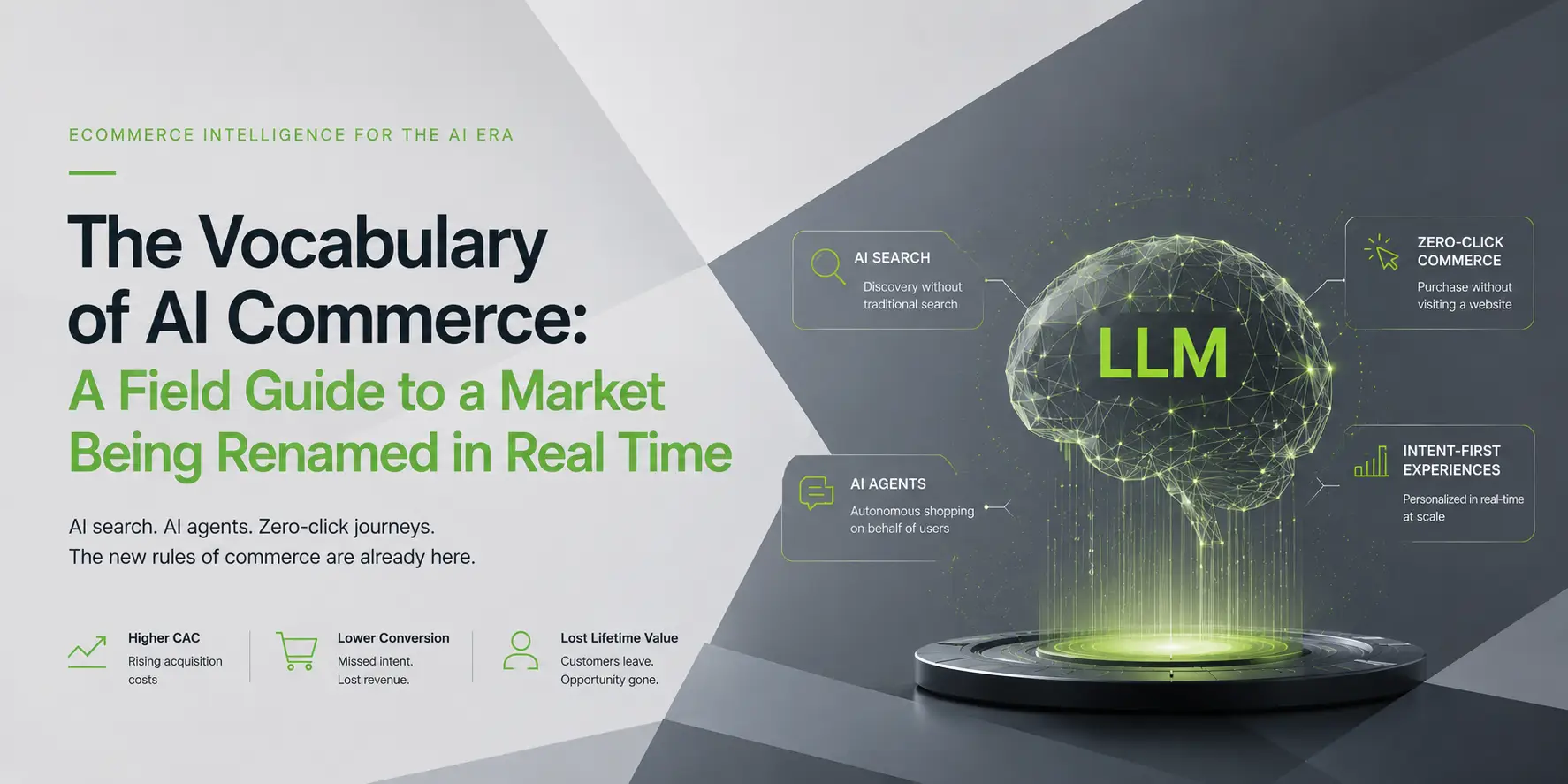
The Vocabulary of AI Commerce: A Field Guide to a Market Being Renamed in Real Time
A working reference for ecommerce leadership, product teams, and the investors underwriting the next decade of commerce infrastructure.
Introduction: The Buyer Is Changing, Not Just the Channel
Most ecommerce vocabulary changes slowly. "Conversion rate optimization" has meant roughly the same thing for fifteen years. "Headless commerce" took the better part of a decade to go from conference buzzword to default architecture. That pace has broken. In the last eighteen months, ecommerce has generated more new terminology — Agentic Commerce, Agent-to-Agent Commerce, Retrieval-Optimized Commerce, Entity Commerce — than in the previous ten years combined, and a meaningful share of it is no longer speculative. It is shipping in production, moving real transactions, and being written into payment-network rulebooks.
Here is the uncomfortable part for anyone still running a Q4 roadmap built around organic search and paid social: a large share of merchants are optimizing for a buyer that is quietly being replaced. Google, OpenAI, Anthropic, Microsoft, Visa, and Mastercard are not building "AI features." They are building the infrastructure for software to shop, negotiate, and pay on a human's behalf. Stripe and OpenAI's Agentic Commerce Protocol, Google's Agent Payments Protocol and Universal Commerce Protocol, and the Agent2Agent protocol that now underlies all of them are not demos. As of mid-2026 they are live, they are multi-billion-dollar-network-backed, and they already touch millions of merchants, whether those merchants have opted in or not.
This is the actual thesis of this article, and it is worth stating plainly before anything else: the biggest shift in commerce right now is not "AI-powered tools." It is that software is becoming the buyer. A chat interface reads your product feed, reasons about fit, negotiates fulfillment terms, authorizes a payment, and completes a purchase — with a human approving the outcome rather than clicking through ten product pages to get there. Every term in this guide is downstream of that one fact. Some of the vocabulary below is already load-bearing infrastructure. Some of it is a reasonable prediction dressed up as a category. Part of this guide's job is telling you which is which, because conflating the two is currently costing ecommerce leadership real budget and real strategic attention.
Why an Entirely New Ecommerce Vocabulary Is Emerging
New vocabulary shows up when the underlying technical substrate changes enough that old mental models stop being useful. Four shifts are doing that work right now, and none of them require a computer science degree to understand at a working level — which is the level ecommerce leaders actually need.
Large language models (LLMs) changed the interface. For thirty years, "search" meant matching keywords to an index and ranking results. LLMs instead read a query, reason about intent, and generate an answer — which means the unit of discovery is no longer a ranked list of ten blue links, it's a synthesized recommendation. That single change is why "SEO" stopped being sufficient on its own and terms like AI Search Optimization exist at all.
AI agents changed who acts. An agent is software that can plan a multi-step task and execute it — browse, compare, add to cart, check out — without a human clicking each step. This is the precondition for everything with "agentic" or "autonomous" in the name, and it is also the part of the stack investors are underwriting most aggressively, because an agent that completes a transaction is a new distribution channel merchants have to pay to access, exactly the way paid search and marketplace commissions worked before it.
Retrieval — the practice of pulling live, external data into a model's answer rather than relying only on what the model memorized during training — is what makes AI-generated shopping answers factually current instead of stale. Retrieval is also the reason structured, machine-readable product data has become a strategic asset rather than a technical nicety: a model can only retrieve what is legible to it.
Structured knowledge and reasoning models — knowledge graphs, entity resolution, and models that can hold multi-step logic instead of just pattern-matching text — are what let an agent understand that "waterproof running shoes under $150 that ship to Istanbul by Friday" is a set of constraints to satisfy, not just a string to search. This is the layer where Entity Commerce, Commerce Knowledge Graphs, and Agent-Ready Catalogs all live.
Put together, these four shifts are why the vocabulary below reads less like a list of features and more like a new stack: an interface layer, an execution layer, a data layer, and a trust layer, each generating its own terminology as it matures.
The Evolution of AI Commerce: One Timeline, Not Twenty Trends
The single biggest mistake in how this space gets discussed is treating each term as its own trend. They are not parallel trends. They are stages of one evolutionary line, and reading them as a sequence is the fastest way to understand where the puck is going.
Search Commerce
   ↓  (keyword matching → conversational intent)
Conversational Commerce 2.0
   ↓  (rules-based chat → generative reasoning)
LLM Commerce
   ↓  (browsing a chat answer → acting on it)
Prompt-to-Purchase
   ↓  (single-shot purchase → multi-step task delegation)
Agentic Commerce
   ↓  (one agent, one merchant → agents transacting with merchant agents)
Agent-to-Agent Commerce
   ↓  (human approves each step → human sets constraints, agent executes end-to-end)
Autonomous Shopping
Each arrow above represents a real capability gap that had to close before the next term could mean anything. You could not have Agentic Commerce before LLMs could reliably hold multi-step intent. You could not have Agent-to-Agent Commerce before there was a standardized way for one company's agent to talk to another company's agent — which is precisely what Google's Agent2Agent (A2A) protocol, now governed by the Linux Foundation with over 150 participating organizations, was built to solve. And you cannot have durable Autonomous Shopping without the trust and authorization layer — mandates, verifiable credentials, spend limits — that Google's Agent Payments Protocol (AP2) and the Stripe/OpenAI Agentic Commerce Protocol (ACP) are racing to standardize right now. The timeline is not a metaphor. It is a dependency chain, and most merchants are currently positioned two or three steps behind the leading edge of it.
The 20 Concepts Reshaping Ecommerce Vocabulary
What follows are not dictionary definitions. Each concept below is treated as a mini-analysis: what problem it solves, who is actually building it, what merchants tend to misunderstand about it, and what to do about it. Where a term is still emerging or contested, that is stated explicitly rather than smoothed over.
1. Agentic Commerce
What it is: Commerce transactions initiated, negotiated, or completed by an AI agent acting on a person's behalf, rather than a human clicking through a storefront. This is the umbrella term for the entire category — most of the other 19 concepts are either inputs to it or specializations of it.
Why it emerged: Once LLM-based assistants could reliably hold a multi-step goal ("find me a gift under $80, my sister likes minimalist jewelry, ship by Friday"), the natural next step was letting them finish the job instead of handing back a list of links. Chat interfaces already had the attention; commerce infrastructure had to catch up to where the attention was.
How it works: An agent reads intent, queries a merchant's product data (via a feed, an API, or a protocol like ACP), assembles a cart, and either completes checkout with a delegated payment credential or hands the user a one-tap confirmation.
Real-world signal: This is not speculative. OpenAI's Instant Checkout, built on the Agentic Commerce Protocol co-developed with Stripe, already lets ChatGPT users in the U.S. buy directly from Etsy sellers, with Shopify merchants (Glossier, Vuori, Spanx, SKIMS among the named early partners) and Walmart-adjacent grocery via Instacart rolling in behind it.
Who's investing: OpenAI, Stripe, Shopify, Visa, Mastercard, Google, Perplexity, Microsoft. This is one of the few AI-commerce categories with hard payment-network backing rather than just vendor marketing.
Old way vs. new way: Old — human browses, compares, clicks "buy." New — human states a goal, agent executes the steps, human approves or auto-approves within a spend limit.
Common misconception: That agentic commerce means no human oversight at all. Every live implementation today keeps a human-authorization step (approve, confirm, spend-limit) — full autonomy is a later stage, not where we are.
Practical implication for merchants: If your checkout, product feed, and return policy aren't legible to an agent, you are invisible to a growing slice of high-intent demand — for free discovery, but at the cost of a transaction fee once a sale converts (OpenAI's ACP charges merchants a per-transaction fee on completed Instant Checkout purchases).
Q: Does agentic commerce replace a merchant's own website?A: No — merchants typically remain merchant of record and fulfill the order; the agent is a new front door, not a replacement storefront.Future outlook: Expect agentic checkout to become table stakes for DTC brands within 2–3 years, the way mobile checkout did after 2015.
Related concepts: Agent-to-Agent Commerce, Prompt-to-Purchase, Autonomous Shopping.
2. AI-Native Commerce
What it is: A design philosophy for commerce platforms built assuming AI agents and AI-generated answers are a primary customer, not a bolt-on channel. It's an architectural stance, not a single feature.
Why it emerged: Retrofitting a decade-old ecommerce stack — built around a human scrolling a page — to serve an AI agent reading a JSON feed exposes structural gaps: hidden pricing logic, JavaScript-rendered content invisible to crawlers, inconsistent product identifiers. AI-native platforms are being built to avoid those gaps from day one.
How it works: AI-native systems expose canonical, structured representations of catalog, inventory, and policy as a first-class API surface (often the same surface used internally), rather than generating them as an afterthought scrape of the storefront.
Real-world signal: Shopify's investment in agent-facing infrastructure (its role as an ACP launch partner, structured storefront APIs) and a wave of "headless-for-agents" startups are early evidence of this shift, though the category label itself is still forming.
Who's investing: Shopify, BigCommerce, commercetools, and a growing set of composable-commerce vendors positioning against legacy monoliths.
Old way vs. new way: Old — build for the browser, add an API later. New — build the canonical data model first; the browser is one of several renderers of it.
Common misconception: That "AI-native" is marketing shorthand for "has a chatbot." Most vendors using the term that way are describing Conversational Commerce 2.0, not an architectural rebuild.
Practical implication for merchants: Before rebuilding anything, audit whether your current platform can serve a clean, consistent product-and-policy feed to an external agent without custom scraping — that gap, not the lack of a chatbot, is the real AI-native deficit.
Q: Is AI-native commerce the same as headless commerce?A: Related but not identical — headless separates frontend from backend; AI-native additionally assumes a non-human, non-browser consumer of that backend.Future outlook: This term will likely consolidate into "modern commerce architecture" within a few years rather than surviving as a distinct category — but the underlying practice will be standard.
Related concepts: Machine-Readable Storefront, Agent-Ready Catalog, Structured Commerce Data.
3. Conversational Commerce 2.0
What it is: The successor to WhatsApp/Messenger-era conversational commerce, upgraded from scripted, rules-based chatbots to LLM-driven assistants capable of open-ended, context-aware dialogue that can actually complete a purchase rather than route to a human agent.
Why it emerged: First-generation conversational commerce (2016–2021) mostly automated customer service scripts and struggled with anything outside a decision tree. LLMs removed that ceiling, making genuinely useful shopping dialogue possible for the first time.
How it works: An LLM-based assistant, grounded in a merchant's catalog and policies via retrieval, holds a multi-turn conversation, narrows preferences, and either recommends or transacts.
Real-world signal: Shopify's Sidekick, Salesforce's Agentforce for commerce, and Microsoft Copilot's shopping integrations are current examples of assistants operating at this second-generation level rather than the old decision-tree model.
Who's investing: Shopify, Salesforce, Microsoft, and most CDP/marketing-automation vendors repositioning their chat products.
Old way vs. new way: Old — "Type 1 for returns, 2 for order status." New — "I'm looking for a birthday gift for someone who hates clutter" understood and acted on directly.
Common misconception: That any chatbot with an LLM behind it qualifies. The meaningful bar is whether it's grounded in live merchant data and can close a transaction, not just answer FAQs more fluently.
Practical implication for merchants: A conversational layer is only as good as the data it's grounded in — most underwhelming "AI chat" deployments fail on retrieval quality, not model quality.
Q: Does Conversational Commerce 2.0 replace search on a storefront?A: It's increasingly positioned alongside search as a parallel discovery path, not a full replacement — most merchants run both.Future outlook: This will likely fold into "Commerce Copilot" as the default merchant-facing name within two years.
Related concepts: Commerce Copilot, LLM Commerce, Intent-Based Commerce.
4. LLM Commerce
What it is: Shopping journeys that begin and largely conclude inside a general-purpose LLM interface (ChatGPT, Gemini, Claude, Copilot) rather than a merchant's own site or app. This term is still emerging and used inconsistently across the industry — treat it as directional, not standardized.
Why it emerged: With ChatGPT alone processing tens of millions of shopping-related queries daily and hundreds of millions of weekly active users, general-purpose chat interfaces have become a discovery surface large enough to warrant its own vocabulary, distinct from "search commerce" or a merchant's own conversational tools.
How it works: The LLM interface retrieves product data (via feeds, plugins, or protocols like ACP/MCP), reasons about fit, and either recommends or completes checkout in-line, without the user visiting the merchant's site.
Real-world signal: OpenAI's Instant Checkout is the clearest production instance; Perplexity's shopping features and Microsoft Copilot's merchant integrations are adjacent examples.
Who's investing: OpenAI, Perplexity, Microsoft, Google (via Gemini and AI Mode in Search).
Old way vs. new way: Old — Google search → merchant site → checkout. New — LLM conversation → in-chat recommendation → in-chat checkout, merchant site optional.
Common misconception: That LLM Commerce is just "chatbots selling things." The distinguishing feature is that the LLM interface itself — not the merchant — owns the customer relationship and the session.
Practical implication for merchants: This is the category most likely to erode direct-traffic economics if merchants don't adapt; treat LLM-referred and LLM-completed sales as a distinct channel in your attribution model now, not later.
Q: Does LLM Commerce cannibalize a brand's own site traffic?A: Early data (Adobe Analytics found AI-referred visitors converting at meaningfully higher rates than traditional search visitors) suggests it adds a high-intent channel rather than purely cannibalizing, but the picture is still forming.Future outlook: Expect this term to be absorbed into "Agentic Commerce" as the umbrella category matures — it currently describes a subset of it.
Related concepts: Zero-Click Commerce, Agentic Commerce, Retrieval-Optimized Commerce.
5. Zero-Click Commerce
What it is: Purchases completed without the customer ever clicking through to the merchant's website — the commerce equivalent of "zero-click search," where an AI answer satisfies the need without a site visit.
Why it emerged: Once an LLM can summarize product options and complete checkout in-line, the click-through — the unit search marketing has been built around for two decades — stops being the default path to a sale.
How it works: The AI surface handles discovery, comparison, and transaction end-to-end; the merchant's own site becomes a fulfillment backend rather than the point of sale.
Real-world signal: Instant Checkout in ChatGPT is a direct instance — the stated design goal is explicitly that "the user never leaves ChatGPT."
Who's investing: OpenAI, Google (AI Mode in Search), Perplexity — anyone competing to own the answer layer.
Old way vs. new way: Old — sessions, page views, and click-through rate as core marketing metrics. New — share of AI-recommendation and share of AI-completed transaction as the metrics that matter, often invisible to a merchant's own web analytics.
Common misconception: That zero-click commerce means merchants lose visibility into the sale entirely. Order and fulfillment data still flow to the merchant; what's lost is on-site behavioral and attribution data.
Practical implication for merchants: Analytics stacks built purely around site sessions will increasingly under-report real demand; merchants need visibility into AI-referral and AI-completed order volume specifically, which most standard analytics platforms don't yet expose cleanly.
Q: Is zero-click commerce bad for brand-building?A: It's a real, unresolved tension — brands lose the on-site storytelling moment, which is why several brands are pushing back on being reduced to a SKU in a feed.Future outlook: This will likely remain a real and growing share of transactions rather than a majority any time soon — but "growing and structurally important" is different from "dominant," and conflating the two overstates near-term risk.
Related concepts: LLM Commerce, AI Product Discovery, Prompt-to-Purchase.
6. Agent-to-Agent Commerce (A2A Commerce)
What it is: Transactions negotiated between a buyer's agent and a merchant's agent directly, rather than a single agent hitting a static API. The "commerce" application of Google's broader Agent2Agent (A2A) protocol.
Why it emerged: A single consumer-facing agent talking to a thousand different merchant backends, each with bespoke integrations, doesn't scale. A2A standardizes discovery ("Agent Cards") and negotiation ("Tasks") so any compliant agent can transact with any compliant merchant agent without custom point-to-point integration.
How it works: A buyer's agent discovers a merchant's agent capabilities via a published Agent Card, negotiates terms (price, fulfillment, substitutions) through a Task exchange, and — where payment is involved — invokes an extension like AP2 to authorize the transaction with cryptographically signed "mandates."
Real-world signal: A2A marked its one-year anniversary in April 2026 with more than 150 participating organizations, governance under the Linux Foundation, a v1.0 release with signed Agent Cards, and production deployments inside Azure AI Foundry and Amazon Bedrock AgentCore — this is one of the more mature, hard-infrastructure entries on this list, not a speculative one.
Who's investing: Google, Microsoft (Azure AI Foundry), Amazon (Bedrock AgentCore), and — notably — IBM, whose competing Agent Communication Protocol merged voluntarily into A2A in 2025.
Old way vs. new way: Old — merchant builds a custom integration per AI platform. New — merchant implements A2A once; any compliant agent, from any vendor, can transact with it.
Common misconception: That agent-to-agent commerce implies merchants lose control of pricing or terms. In practice, the merchant's agent still enforces the merchant's own business rules — A2A standardizes the conversation, not the outcome.
Practical implication for merchants: Watch A2A and its commerce-specific extensions (AP2, and Google's newer Universal Commerce Protocol) as the layer most likely to become mandatory infrastructure rather than optional — protocol adoption at this scale, this fast, historically precedes it becoming a cost of doing business.
Q: Do merchants need a "merchant agent" built from scratch?A: Increasingly no — platform vendors (Shopify, Salesforce, commerce clouds) are building A2A-compliant agent layers merchants can adopt rather than build.Future outlook: Expect A2A to become the de facto "TCP/IP of agent commerce" within 2–3 years, given its current trajectory and neutral governance.
Related concepts: Agentic Commerce, Autonomous Shopping, AI Trust Signals.
7. Commerce Copilot
What it is: An AI assistant embedded directly inside a merchant's own operational tools — dashboard, admin panel, CRM — helping the merchant run the business, as distinct from a customer-facing shopping assistant.
Why it emerged: As merchants adopted more AI-native platforms, the same reasoning capability powering customer-facing chat proved equally useful pointed inward: drafting campaigns, diagnosing a sales dip, summarizing support tickets.
How it works: The copilot sits inside the merchant's admin surface, grounded in that merchant's own store data, and can both answer questions and take bounded actions (adjust a product listing, launch a segment, draft an email) on the merchant's behalf.
Real-world signal: Shopify Sidekick, Salesforce Agentforce, and Microsoft 365 Copilot's integration into commerce workflows are current, shipping examples — this is one of the least contested terms on this list because the products already exist at scale.
Who's investing: Shopify, Salesforce, Microsoft, Adobe.
Old way vs. new way: Old — a merchant manually digs through five dashboards to answer "why did conversion drop this week." New — asks the copilot, which reasons across the underlying data directly.
Common misconception: That a commerce copilot is the same thing as a customer-facing shopping assistant. They serve different users (merchant vs. shopper) and are frequently confused in vendor marketing.
Practical implication for merchants: The near-term ROI case for AI in commerce is often stronger here — internal operational lift — than in flashier customer-facing agentic features, and it's lower-risk to adopt.
Q: Can a commerce copilot make changes without approval?A: Most production implementations today require a human confirmation step for anything with financial or customer-facing impact.Future outlook: This category will likely become a default, bundled feature of commerce platforms rather than a standalone purchase decision.
Related concepts: Conversational Commerce 2.0, AI Merchandising.
8. Intent-Based Commerce
What it is: Designing the shopping experience around a stated goal or constraint set ("I need something for a humid climate, under $200, arriving by the 14th") rather than around keyword-matched product listings.
Why it emerged: Keyword search forces the shopper to translate their actual goal into product-catalog vocabulary. LLMs remove that translation burden, so the industry needed language for designing around raw intent rather than pre-normalized search terms.
How it works: An intent-based system parses natural-language constraints, maps them against structured product attributes (not just titles and descriptions), and returns a constraint-satisfying set rather than a keyword-ranked list.
Real-world signal: Google's AI Mode in Search and shopping-focused LLM interfaces increasingly market themselves around "tell us what you need," which is intent-based framing, though the underlying implementation maturity varies widely by vendor.
Who's investing: Google, Perplexity, and product-discovery vendors serving mid-market ecommerce.
Old way vs. new way: Old — shopper guesses the right keyword, refines with filters. New — shopper states the goal in plain language; the system resolves the filters.
Common misconception: That intent-based commerce is just "better search." The meaningful shift is structural: product data has to be tagged with attributes rich enough to satisfy constraint-based queries, which most legacy catalogs are not.
Practical implication for merchants: Catalog attribute richness (materials, fit, use-case, climate suitability, compatibility) becomes a genuine competitive input, not just an SEO nicety — thin product data is invisible to constraint-based matching regardless of how well-written the title is.
Q: Does intent-based commerce require rebuilding the catalog?A: Not rebuilding, but auditing attribute completeness is usually the highest-leverage first step.Future outlook: Likely to become an invisible default behavior of search and AI interfaces rather than a distinct marketed feature.
Related concepts: AI Product Discovery, Entity Commerce, Structured Commerce Data.
9. Autonomous Shopping
What it is: The end-state of the evolutionary chain: an agent completing an entire purchase journey — discovery, comparison, negotiation, payment — within constraints a human set in advance, without step-by-step approval.
Why it emerged: It's the logical terminus once agentic commerce, agent-to-agent negotiation, and authorized-payment protocols (AP2-style mandates) all mature and compose together — this term names the destination, not a currently shipping mainstream product.
How it works (conceptually): A user sets a standing intent and spend/behavior boundaries ("restock protein powder monthly, under $60, from a brand I've bought before"); the agent monitors, decides, and transacts within those bounds, reporting outcomes rather than requesting approval each time.
Real-world signal: This should be treated as emerging/experimental, not mainstream. AP2's mandate architecture (Intent, Cart, Payment mandates as verifiable credentials) is explicitly designed to eventually support this, and Mastercard's Agent Pay for Machines is built for machine-speed, low-friction transactions — but full unsupervised purchase loops in production, for consumer retail, are the exception, not the norm, in mid-2026.
Who's investing: Google (AP2), Mastercard (Agent Pay for Machines), Visa (Intelligent Commerce), and stablecoin-rail participants (Coinbase, via the A2A x402 extension) betting on machine-speed micropayments as part of this future.
Old way vs. new way: Old — human approves every transaction. New — human approves a policy once; the agent operates inside it indefinitely.
Common misconception: That autonomous shopping is already widely deployed for everyday retail. It is not — recurring, low-risk replenishment categories are the realistic near-term use case, not discretionary or high-value purchases.
Practical implication for merchants: This is a 3–5 year strategic bet, not a 2026 roadmap item — the trust and liability infrastructure (who's responsible when an autonomous purchase goes wrong) is still being negotiated at the protocol and regulatory level.
Q: What's actually blocking autonomous shopping from being mainstream today?A: Liability and trust infrastructure, not model capability — networks and regulators are still working out who bears risk when an agent, not a human, authorizes a charge.Future outlook: Expect narrow, low-risk categories (subscriptions, replenishment, commoditized staples) to go autonomous first; discretionary and considered purchases last.
Related concepts: Agent-to-Agent Commerce, AI Trust Signals, Agentic Commerce.
10. AI Product Discovery
What it is: The process by which AI systems — LLM interfaces, AI-enhanced search, shopping assistants — surface products to a user, as distinct from the transaction itself.
Why it emerged: Discovery and checkout are increasingly separable events happening in different systems (an LLM surfaces the product, a different protocol completes the sale), so the industry needed a term for the discovery half specifically.
How it works: Discovery systems retrieve candidate products from structured feeds or crawled/indexed data, rank them against inferred intent, and present a small, reasoned shortlist rather than an exhaustive ranked list.
Real-world signal: ChatGPT Shopping's product-recommendation surface (distinct from Instant Checkout) and Google's AI Mode shopping results are current, high-volume examples of discovery decoupled from transaction.
Who's investing: OpenAI, Google, Perplexity, Amazon (Rufus).
Old way vs. new way: Old — discovery and purchase both happen on the same ranked results page. New — discovery happens in a conversational answer; purchase may happen elsewhere or in-line, on a different protocol entirely.
Common misconception: That being "discovered" by an AI system guarantees traffic or sales the way a high SEO ranking used to. Several of these discovery surfaces (product recommendations inside ChatGPT, for instance) are currently free to appear in, but visibility doesn't equal a guaranteed click or conversion.
Practical implication for merchants: Structured, accurate, current product data is now a discovery-layer requirement, not just a nice-to-have for on-site search — an AI system generally can't recommend what it can't confidently parse.
Q: Is AI product discovery paid or organic?A: Currently mostly free/organic for base visibility (e.g., ChatGPT Shopping discovery), with transaction fees applying only once a sale completes through a protocol like ACP — this may shift as the channel matures.Future outlook: Expect a "AI shelf placement" dynamic to emerge — competition for being the recommended option, not just a listed one.
Related concepts: AI Search Optimization, Zero-Click Commerce, Entity Commerce.
11. Prompt-to-Purchase
What it is: The compressed journey from a single natural-language prompt directly to a completed transaction, with minimal or no intermediate browsing steps.
Why it emerged: As checkout got embedded directly into chat interfaces, the gap between "asking a question" and "completing a purchase" collapsed from many steps to sometimes one confirmation tap — this term names that compression specifically.
How it works: A single prompt triggers intent parsing, product matching, cart assembly, and a payment-authorization request in one flow, typically ending in a single human confirmation rather than a multi-page checkout.
Real-world signal: Instant Checkout in ChatGPT is the cleanest current example — recommendation and purchase can occur in the same conversational turn.
Who's investing: OpenAI, Stripe (as the payment rail), and merchants opting into ACP.
Old way vs. new way: Old — search, click, browse, compare, add to cart, enter shipping, enter payment, confirm (7+ steps). New — prompt, confirm (2 steps).
Common misconception: That prompt-to-purchase means no consideration or comparison happens. The comparison still happens — it's just performed by the model on the user's behalf rather than by the user clicking between tabs.
Practical implication for merchants: Being the option surfaced in that single prompt matters enormously more than in a ten-result list — the "position zero" dynamic from search is even more concentrated here, and there's currently no established playbook for winning that position reliably.
Q: Does prompt-to-purchase reduce average order value?A: Not established either way yet — early data is too thin and vendor-specific to generalize confidently.Future outlook: Likely to remain concentrated in low-consideration, well-specified purchases (replenishment, gifts with clear constraints) rather than complex or high-value considered purchases.
Related concepts: Agentic Commerce, Zero-Click Commerce, LLM Commerce.
12. AI Merchandising
What it is: Using AI — generative and predictive — to perform merchandising tasks: assortment planning, dynamic bundling, personalized ranking, and pricing/promotion decisions, historically done manually by merchandising teams.
Why it emerged: Merchandising has always been data-heavy and pattern-driven — exactly the kind of task machine learning has handled well for years — but generative AI added the ability to also produce the creative assets (descriptions, imagery, bundle framing) merchandising requires, not just the underlying analysis.
How it works: Models analyze sales, inventory, and behavioral data to recommend assortment and pricing actions, and increasingly generate supporting creative (product copy, imagery variants, bundle suggestions) directly.
Real-world signal: This is one of the more mature, less contested categories — predictive merchandising tools have been in enterprise use for years; what's new is generative creative production layered on top, offered by most major commerce platforms and specialized vendors.
Who's investing: Salesforce, Adobe, Shopify, and a long tail of specialized merchandising-AI vendors.
Old way vs. new way: Old — merchandising team manually curates assortment and pricing on a fixed cadence. New — continuous, model-driven recommendations, with humans setting strategy and approving exceptions.
Common misconception: That AI merchandising removes the need for merchandising expertise. In practice it shifts the human role toward strategy and judgment calls (brand fit, exceptions, taste) rather than eliminating it.
Practical implication for merchants: This is one of the lowest-risk, highest-ROI near-term AI investments on this list — it doesn't require new payment infrastructure or protocol adoption, just better data hygiene and a willing merchandising team.
Q: Is AI merchandising the same as dynamic pricing?A: Dynamic pricing is one component of it, not the whole category — assortment, bundling, and creative production are equally central.Future outlook: Will likely become a standard, expected feature of commerce platforms rather than a differentiator within a few years.
Related concepts: Commerce Copilot, AI Product Discovery.
13. AI Search Optimization (AISO)
What it is: The practice of optimizing product and brand content so it is favorably retrieved and cited by AI-generated answers — the emerging counterpart to SEO. Note: this space also uses the terms Generative Engine Optimization (GEO) and Answer Engine Optimization (AEO), and the industry has not settled on one standard name — treat all three as describing largely the same practice from different vendors.
Why it emerged: Once a meaningful share of discovery happens inside AI-generated answers rather than ranked search results, "ranking #1" stops being the target — "being the answer the model gives" is.
How it works: Practitioners focus on structured data accuracy (schema.org markup, accurate specs), content clarity for retrieval (unambiguous, well-labeled facts an LLM can extract confidently), and third-party citation signals (reviews, mentions, comparisons) that models draw on when generating an answer.
Real-world signal: A growing wave of agencies and tools now explicitly sell "GEO" or "AISO" audits; this is a real emerging discipline, but — important caveat — there is no equivalent yet to Google Search Console giving merchants direct visibility or control over how often they're cited inside a given AI answer.
Who's investing: A fast-growing vendor ecosystem (analytics and optimization startups), plus traditional SEO agencies repositioning.
Old way vs. new way: Old — optimize for keyword ranking and backlinks. New — optimize for retrieval accuracy and citation-worthiness in a generated answer.
Common misconception: That AISO is a solved discipline with reliable, measurable tactics the way SEO eventually became. It is genuinely early — treat most current "AISO playbooks" as informed hypotheses, not proven methodology.
Practical implication for merchants: The lowest-regret action right now is structural, not tactical: clean, accurate, schema.org-marked-up product data reduces the chance of an AI system misrepresenting or ignoring you, regardless of how the optimization discipline matures.
Q: Should merchants abandon SEO for AISO?A: No — traditional search still drives the majority of discovery traffic for most merchants in 2026; AISO is additive, not a replacement, at this stage.Future outlook: Expect consolidation around one or two standard terms and the first reliable measurement tools within 12–18 months.
Related concepts: Retrieval-Optimized Commerce, AI Trust Signals, Structured Commerce Data.
14. Entity Commerce
What it is: Treating products, brands, and merchants as distinct, resolvable "entities" with a consistent identity across data sources — the commerce application of the entity-resolution concept long used in Google's Knowledge Graph.
Why it emerged: AI systems reason more reliably about a well-defined entity ("this specific SKU, from this specific brand, with these specific attributes") than about loosely matched text strings — entity clarity reduces hallucination and misattribution in AI-generated answers.
How it works: Products and brands are assigned stable identifiers and structured attributes that stay consistent across a merchant's site, marketplaces, and any third-party feed, letting an AI system confidently resolve "this product" as the same entity everywhere it appears.
Real-world signal: This concept draws directly from established Google Knowledge Graph and schema.org practice — it is well-grounded academically and in search infrastructure, though "Entity Commerce" as a packaged commerce term is still emerging in industry usage.
Who's investing: Google (as the entity-resolution infrastructure owner), plus PIM (product information management) vendors like Akeneo and Salsify building entity-consistency tooling.
Old way vs. new way: Old — the same product described inconsistently across site, marketplace, and ads feed, with different titles and attributes each time. New — one canonical entity, referenced consistently everywhere.
Common misconception: That entity resolution is purely a technical/SEO concern. It directly affects whether an AI agent can confidently recommend or transact on a product at all — inconsistent entities create ambiguity agents are built to avoid acting on.
Practical implication for merchants: A product information management (PIM) audit — checking for consistent naming, identifiers, and attributes across every channel — is one of the highest-leverage, lowest-glamour investments a merchant can make right now.
Q: Is entity commerce the same as having good product IDs (SKUs, GTINs)?A: Stable IDs are necessary but not sufficient — entity commerce also requires consistent descriptive attributes attached to that ID everywhere it appears.Future outlook: Will likely remain foundational infrastructure rather than a customer-facing feature — invisible when done well, costly when neglected.
Related concepts: Commerce Knowledge Graph, Structured Commerce Data, Machine-Readable Storefront.
15. Machine-Readable Storefront
What it is: A storefront designed so that its product data, pricing, availability, and policies can be reliably parsed by software (crawlers, agents, protocols) — not just rendered for a human eye.
Why it emerged: Many storefronts render critical information (price, stock status, shipping terms) via client-side JavaScript in ways that are trivial for a human to read but unreliable for automated systems to extract — a gap that matters far more once agents, not just search crawlers, are the audience.
How it works: Structured data markup (schema.org Product, Offer, and related types), clean server-rendered or API-exposed data, and consistent feed formats let external systems extract accurate facts without fragile scraping.
Real-world signal: This underpins every protocol on this list — ACP's "cart and feed" building block and Google's UCP both explicitly depend on merchants exposing machine-readable catalog and checkout data; it is a hard prerequisite, not an optional enhancement.
Who's investing: Every major platform (Shopify, BigCommerce, Salesforce Commerce Cloud) is building this into core infrastructure rather than treating it as a plugin.
Old way vs. new way: Old — "does it look right in a browser?" New — "can a script reliably extract the price, stock status, and policy terms without guessing?"
Common misconception: That having a REST API automatically makes a storefront machine-readable in the sense that matters here. An API a developer must custom-integrate is different from a standardized feed an arbitrary agent can parse without bespoke work.
Practical implication for merchants: Run a basic technical audit: does critical purchase information (current price, in-stock status, return window) resolve without JavaScript execution, and is it wrapped in valid schema.org markup? This is a concrete, testable, near-term action item — not a strategic abstraction.
Q: Is a machine-readable storefront the same as an agent-ready catalog?A: Closely related — the storefront is the delivery surface; the catalog is the underlying data. You generally need both.Future outlook: Will likely become a baseline technical requirement, similarly to mobile responsiveness after 2015 — non-negotiable, not differentiating.
Related concepts: Agent-Ready Catalog, Structured Commerce Data, AI-Native Commerce.
16. Commerce Knowledge Graph
What it is: A structured network of relationships between products, brands, categories, attributes, and customer intents — allowing an AI system to reason about connections ("this bag pairs with that jacket," "this ingredient is a substitute for that one") rather than just matching flat records.
Why it emerged: Flat product catalogs (rows in a database) don't encode relationships. As AI systems took on more reasoning-heavy tasks (substitution, complementary recommendation, constraint satisfaction), the industry needed a data structure that encodes relationships explicitly rather than leaving a model to infer them unreliably from text.
How it works: Products, attributes, and intents are modeled as connected nodes and edges (a graph) rather than isolated rows, letting reasoning systems traverse relationships directly.
Real-world signal: This is a well-established concept in search and enterprise data (Google's own Knowledge Graph, enterprise graph databases like Neo4j in retail use), but a commerce-specific packaged version of it, marketed as "Commerce Knowledge Graph," is still an emerging category rather than a mainstream, off-the-shelf product for most merchants.
Who's investing: Google, graph-database vendors (Neo4j), and a small number of specialized commerce-AI startups.
Old way vs. new way: Old — recommendation logic hard-coded or inferred statistically from purchase co-occurrence. New — relationships modeled explicitly and reasoned over directly.
Common misconception: That any recommendation engine qualifies as a knowledge graph. Statistical "customers also bought" recommendations are a different, older technique from an explicitly modeled relational graph.
Practical implication for merchants: Building a full commerce knowledge graph is realistically an enterprise-scale investment right now — mid-market merchants should focus on the entity-and-attribute hygiene work (Entity Commerce, Structured Commerce Data) that would make adopting one easier later, rather than building bespoke graph infrastructure today.
Q: Do small and mid-size merchants need their own knowledge graph?A: Generally not yet — this is currently an enterprise-tier investment; most value for smaller merchants comes from clean underlying data, which platform-level graphs can later draw on.Future outlook: Likely to be offered increasingly as a platform-level capability (built into Shopify, Salesforce, etc.) rather than something individual merchants build themselves.
Related concepts: Entity Commerce, Retrieval-Optimized Commerce.
17. Agent-Ready Catalog
What it is: A product catalog specifically structured, validated, and formatted to be consumed reliably by AI shopping agents — the catalog-layer counterpart to a machine-readable storefront.
Why it emerged: Protocols like ACP and UCP define a "feed" building block agents query directly; a catalog that's merely human-browsable often fails validation against these feed specifications (missing required fields, inconsistent units, ambiguous availability status).
How it works: Catalog data is validated against the specific schema a given protocol requires (product identifiers, price, availability, fulfillment options, policy terms), with automated checks catching gaps before an agent encounters them.
Real-world signal: Stripe's Agentic Commerce Suite (launched to simplify ACP adoption) and Shopify's ACP onboarding tooling are direct examples of vendors building specifically to help merchants pass this bar.
Who's investing: Stripe, Shopify, and PIM vendors extending their tools to validate against agent-facing feed specs.
Old way vs. new way: Old — one product feed, formatted loosely for a shopping-ads spec (like Google Merchant Center). New — feed data validated against multiple, stricter agent protocol specifications (ACP, UCP), each with its own required fields.
Common misconception: That an existing Google Merchant Center or Meta product feed is automatically "agent-ready." Agent protocols often require additional fields (fulfillment options, structured policy terms, capability negotiation data) that shopping-ads feeds don't include.
Practical implication for merchants: Multi-protocol reality is already here — ACP, UCP, and MCP-based feeds are not identical, so merchants operating across ChatGPT, Gemini, and Copilot surfaces should expect to maintain more than one feed structure, not a single universal one, for the foreseeable future.
Q: Is there one universal agent-ready feed standard yet?A: No — ACP (OpenAI/Stripe), UCP (Google), and MCP-based approaches currently coexist rather than having converged.Future outlook: Expect either partial convergence between ACP and UCP, or the emergence of tooling that auto-translates between them — full standardization within a year is unlikely given the number of well-funded competing stakeholders.
Related concepts: Machine-Readable Storefront, Structured Commerce Data, Agentic Commerce.
18. AI Trust Signals
What it is: Verifiable evidence — cryptographic, reputational, or behavioral — that lets an AI agent (or the network authorizing its payment) confirm a merchant, product claim, or transaction is legitimate before acting on it.
Why it emerged: When a human buys something, they read reviews, recognize a brand, and trust their own judgment. An agent transacting autonomously needs a machine-verifiable substitute for that judgment — this is precisely the gap Google's AP2 "mandates" (signed, verifiable-credential-based proof of what a user actually authorized) and Visa/Mastercard's tokenized agent-credentialing systems are built to close.
How it works: Cryptographically signed credentials (verifiable credentials, tokenized payment authorizations) travel with a transaction request, letting each party in the chain — agent, merchant, payment network — verify authenticity without relying on a human's judgment call.
Real-world signal: This is one of the more concretely engineered concepts on this list: AP2's Intent, Cart, and Payment Mandates, and Visa's tokenized-credential approach to agent authorization, are shipping, named, technical mechanisms — not abstractions.
Who's investing: Google, Visa, Mastercard, Coinbase (crypto-rail verification via the x402 extension), and enterprise identity vendors.
Old way vs. new way: Old — trust established through brand recognition, reviews, and a human's own risk judgment at checkout. New — trust established (additionally) through cryptographic proof of authorization and identity, verifiable by machines in milliseconds.
Common misconception: That "AI trust signals" mainly means customer-facing trust badges (review counts, verified-buyer tags). The more consequential layer is the machine-to-machine authorization infrastructure most shoppers will never directly see.
Practical implication for merchants: Adopting a payment network's agent-authorization tooling (as it becomes available through your existing processor) will likely become necessary simply to be reachable by agent-driven transactions at all, independent of any customer-facing trust-badge strategy.
Q: Who is liable if an autonomously authorized agent transaction turns out to be fraudulent?A: This is still being actively worked out at the protocol and network level — it's one of the least resolved questions in this entire space.Future outlook: Expect this to become a mandatory, invisible layer of payment infrastructure — similar to how EMV chip authentication became a background requirement rather than a customer-facing feature.
Related concepts: Agent-to-Agent Commerce, Autonomous Shopping.
19. Structured Commerce Data
What it is: Product, pricing, and policy information formatted in standardized, machine-parseable schemas (schema.org, GS1 identifiers, protocol-specific feed formats) rather than free text — the base-layer input every other concept in this guide ultimately depends on.
Why it emerged: This is the least "new" concept on this list — structured data (schema.org markup, GTINs, GS1 standards) predates the current AI wave by well over a decade. What's new is how much more consequential it has become: an AI agent's ability to act correctly depends entirely on data structure quality in a way a human browsing a page never did.
How it works: Product and policy facts are tagged with standardized, unambiguous schema rather than embedded loosely in prose or images, so any downstream system — search crawler, LLM, agent — can extract them reliably.
Real-world signal: Every protocol discussed in this guide — ACP, UCP, AP2, A2A — is built on top of structured data requirements; none of them function on unstructured content. This is the single most load-bearing, least glamorous concept in the entire vocabulary.
Who's investing: Effectively every serious player in this space, since it's a shared dependency rather than a differentiator.
Old way vs. new way: Old — structured data as an SEO nicety, often implemented inconsistently or skipped. New — structured data as the literal precondition for being visible to, and transactable with, AI agents at all.
Common misconception: That this is a "solved problem" merchants can deprioritize because it's not new. In practice, structured-data quality remains one of the most common, most fixable gaps blocking merchants from every other concept in this guide.
Practical implication for merchants: If a leadership team has to choose exactly one investment from this entire article to prioritize first, it should be this one — a structured-data and PIM audit has the highest ratio of leverage to cost of anything covered here.
Q: Is this just "good SEO practice" rebranded?A: Largely yes in technique, but the stakes have changed — this used to affect search ranking; it now affects whether an agent can transact with you at all.Future outlook: Will remain foundational and largely invisible — the equivalent of plumbing, not a feature anyone markets around.
Related concepts: Machine-Readable Storefront, Entity Commerce, Agent-Ready Catalog.
20. Retrieval-Optimized Commerce
What it is: Structuring commerce content and data specifically to be retrieved accurately by retrieval-augmented generation (RAG) systems — the practice of making sure an AI system, when it looks something up live, finds and surfaces the right, current answer about your products.
Why it emerged: LLMs' training data goes stale and can't reflect real-time price or stock changes. Retrieval is the mechanism that keeps AI answers current, and "optimizing for retrieval" emerged as the natural extension of AISO/GEO once practitioners realized ranking and retrieval are related but distinct problems.
How it works: Content and data are chunked, labeled, and structured in ways that make the correct, current fact easy for a retrieval system to find and surface with high confidence — distinct from writing content for a human reader or for a traditional search ranking algorithm.
Real-world signal: Every AI shopping surface discussed in this guide (ChatGPT Shopping, Google AI Mode, Perplexity) depends on retrieval rather than the model's static training data for current price and availability — this is a working, necessary mechanism today, even though "Retrieval-Optimized Commerce" as a named discipline is still forming.
Who's investing: AI platform vendors (OpenAI, Google, Anthropic) building the retrieval infrastructure itself, plus emerging AISO/GEO tooling vendors building merchant-facing optimization products on top of it.
Old way vs. new way: Old — content written once, optimized for keyword ranking, and left mostly static. New — data structured for reliable live retrieval, with freshness and unambiguous labeling treated as ranking factors in their own right.
Common misconception: That retrieval-optimization is identical to AISO/GEO. They overlap heavily but retrieval-optimization is more specifically about data freshness and unambiguous chunking, while AISO/GEO also covers broader citation and reputation signals.
Practical implication for merchants: Stale or contradictory data across channels (a price on your site that doesn't match a marketplace listing) is actively harmful here — retrieval systems have no reliable way to know which source is authoritative, and may surface the wrong one to a shopper or agent.
Q: Does this require a separate content strategy from AISO?A: Not a separate strategy, but a distinct checklist item within it — freshness and cross-channel consistency, specifically.Future outlook: Likely to merge fully into AISO/GEO practice as the discipline matures and standardizes, rather than remaining a distinct named category long-term.
Related concepts: AI Search Optimization, Structured Commerce Data, LLM Commerce.
Comparison Table: Adoption, Purpose, and Who Actually Benefits
| Concept | Current adoption (mid-2026) | Primary purpose | Who benefits most | Expected maturity | Should merchants act now? |
|---|---|---|---|---|---|
| Agentic Commerce | Live, growing fast | Enable agent-initiated purchases | DTC brands, marketplaces | 1–2 years to mainstream | Yes |
| AI-Native Commerce | Emerging architecture shift | Design platforms for non-human consumers | Platform vendors, enterprise merchants | 2–4 years | Assess, don't rebuild yet |
| Conversational Commerce 2.0 | Mainstream on major platforms | LLM-driven shopping dialogue | Mid-to-large merchants | Mature now | Yes |
| LLM Commerce | Emerging, high volume | Shopping journeys inside chat interfaces | Merchants with clean feeds | 1–2 years | Yes |
| Zero-Click Commerce | Emerging, real but partial | Complete purchase without site visit | AI platforms; merchants with agent-ready checkout | 2–3 years to material share | Monitor closely |
| Agent-to-Agent Commerce | Live infrastructure, early commerce use | Standardize agent-to-agent negotiation | Platform and infra vendors | 2–3 years | Monitor / pilot |
| Commerce Copilot | Mainstream | AI assistance for merchant operations | All merchant sizes | Mature now | Yes |
| Intent-Based Commerce | Emerging | Match constraint-based intent, not keywords | Merchants with rich attribute data | 2–3 years | Audit catalog attributes |
| Autonomous Shopping | Experimental | Fully unsupervised agent purchasing | Payment networks, replenishment categories | 3–5 years | Not yet — monitor |
| AI Product Discovery | Mainstream, high volume | Surface products via AI reasoning | Well-structured catalogs | Mature now | Yes |
| Prompt-to-Purchase | Emerging | Collapse journey to one prompt + confirm | Low-consideration categories | 1–2 years | Yes, for eligible SKUs |
| AI Merchandising | Mainstream | Automate assortment, pricing, creative | All merchant sizes | Mature now | Yes |
| AI Search Optimization (AISO) | Emerging, fast-growing vendor category | Optimize for AI-generated answers | All merchants, especially content-thin ones | 1–2 years to standardize | Start now, expect method to evolve |
| Entity Commerce | Emerging as named category; underlying practice mature | Consistent product/brand identity across channels | Multi-channel merchants | 2–3 years | Yes — PIM audit |
| Machine-Readable Storefront | Becoming baseline requirement | Let software extract accurate store data | Everyone transacting with agents | Near-term mandatory | Yes, urgently |
| Commerce Knowledge Graph | Experimental for most; mature for enterprise | Model relationships between products/intents | Large, complex catalogs | 3–4 years for mid-market | Not yet for most SMBs |
| Agent-Ready Catalog | Emerging, protocol-dependent | Feed data validated for agent protocols | Merchants on Shopify/Stripe-adjacent stacks | 1–2 years | Yes |
| AI Trust Signals | Emerging, protocol-level | Machine-verifiable authorization and legitimacy | Payment networks, agent platforms | 2–3 years | Adopt via your payment processor |
| Structured Commerce Data | Mature practice, rising stakes | Foundational machine-parseable data | Everyone | Mature now, non-negotiable | Yes — top priority |
| Retrieval-Optimized Commerce | Emerging | Ensure accurate live AI retrieval of your data | Merchants with frequently changing data | 1–2 years | Yes |
How These Concepts Connect: The Ecosystem, Not the List
Read individually, these terms look like twenty separate trends. Read as a stack, they resolve into a small number of dependency chains. The most important one runs from raw data hygiene up to autonomous transaction, and it looks like this:
Structured Commerce Data
   ↓  (facts get organized into identity)
Entity Commerce
   ↓  (identity gets surfaced through the storefront)
Machine-Readable Storefront
   ↓  (storefront data gets packaged for agents specifically)
Agent-Ready Catalog
   ↓  (catalog gets connected into relational reasoning)
Commerce Knowledge Graph
   ↓  (relational data becomes something to search/reason within)
Entity Commerce feeds into → AI Search Optimization / Retrieval-Optimized Commerce
   ↓  (optimized, retrievable data becomes trustworthy at machine speed)
AI Trust Signals
   ↓  (trusted, retrievable, agent-ready data becomes transactable)
LLM Commerce / Agentic Commerce
Notice what this diagram implies: none of the flashy, headline-grabbing concepts at the bottom (Agentic Commerce, Autonomous Shopping) work without the unglamorous data-layer concepts at the top. This is the single most common strategic mistake ecommerce leadership teams are making right now — chasing a chatbot or an agent integration while skipping the structured-data and entity-consistency work that determines whether that integration actually functions. A merchant with a flawless ACP integration and a messy, inconsistent product catalog will still fail at the point an agent tries to reason about their inventory.
Which Concepts Are Already Real? An Honest Maturity Assessment
Already mainstream — shipping in production at meaningful scale, with real revenue behind it: Conversational Commerce 2.0, Commerce Copilot, AI Merchandising, AI Product Discovery, Structured Commerce Data, and — with genuine payment-network backing — Agentic Commerce via Instant Checkout/ACP. These are not bets; they are current operating reality for a growing share of merchants.
Emerging — real, funded, and moving, but not yet standard practice: LLM Commerce, Zero-Click Commerce, Agent-to-Agent Commerce, Intent-Based Commerce, AI Search Optimization, Entity Commerce, Machine-Readable Storefront, Agent-Ready Catalog, AI Trust Signals, Retrieval-Optimized Commerce, Prompt-to-Purchase. Most of the protocol infrastructure underneath these (A2A, AP2, UCP) is genuinely live — what's emerging is merchant-side adoption and standardized practice, not the underlying technology.
Experimental — technically demonstrated, not yet reliable or widespread in production consumer retail: Autonomous Shopping (outside narrow replenishment cases), Commerce Knowledge Graph at mid-market scale, and full end-to-end machine-authorized transactions without any human confirmation step.
Marketing buzzwords — where the underlying practice is real but the label itself is being used loosely or inconsistently by vendors to describe things that predate this wave: "AI-Native Commerce" is frequently applied to any product with a chatbot bolted on, regardless of architecture; "LLM Commerce" and "AISO/GEO" are used inconsistently across vendors with no settled definition; be skeptical of any vendor pitch that treats these terms as if they were standardized and measurable today, because they largely are not yet.
Frequently Asked Questions
Is Agentic Commerce actually generating revenue today, or is it still a demo-stage concept?
It is generating revenue today. OpenAI's Instant Checkout, built on the Stripe-codeveloped Agentic Commerce Protocol, is live for U.S. ChatGPT users purchasing from Etsy sellers, with Shopify merchant onboarding underway and named brand partners already announced. This is a production channel, not a prototype.
Should a mid-market merchant prioritize ACP, UCP, or wait for consolidation?
Waiting for full consolidation is not a low-risk strategy — both OpenAI/Stripe's ACP and Google's UCP have serious commercial backing and no clear signal either will fold into the other soon. The lower-risk path is investing in the shared prerequisite, structured and agent-ready product data, which pays off regardless of which protocol (or both) a merchant eventually implements.
Does agentic commerce threaten Amazon's marketplace dominance?
It creates a plausible bypass path for DTC brands, since ACP and UCP could route high-intent customers directly to a merchant's own checkout without an Amazon-style marketplace commission. Amazon's own agent, Rufus, currently operates largely within Amazon's own ecosystem, and how open Amazon becomes to external agents is one of the more consequential open questions in this space.
What is the actual difference between MCP, A2A, ACP, AP2, and UCP?
They sit at different layers of the same stack. MCP is a tool-access layer (letting an agent call external tools/data). A2A is agent-to-agent communication and negotiation. AP2 is a payment-authorization layer that extends A2A. ACP (OpenAI/Stripe) and UCP (Google) are competing, higher-level commerce-flow specifications covering cart, checkout, and feed — both of which can call down into AP2-style authorization for payment.
How should CFOs think about the transaction fees these protocols charge?
Treat it as a new, comparable line item to marketplace commission or paid-search cost-per-acquisition, not as a new category of cost. OpenAI's ACP charges merchants a transaction fee on completed Instant Checkout purchases, shoppers pay nothing extra — model it against the incremental, high-intent demand it's expected to generate, the same way you'd underwrite a new paid channel.
Is investing in AI Search Optimization (AISO/GEO) premature given how undefined the discipline still is?
The specific tactics are genuinely unsettled, but the foundational work (clean schema.org markup, unambiguous product attributes, consistent cross-channel data) is valuable regardless of how the discipline matures. Invest in the foundation now; treat vendor-specific "AISO playbooks" with appropriate skepticism until measurement standards exist.
What happens to brand storytelling in a zero-click, prompt-to-purchase world?
This is a genuinely unresolved tension, not a solved problem with a tidy answer. Brands built on on-site narrative and imagery lose that moment when an agent completes the purchase in-chat; some brands are actively resisting full agentic integration for exactly this reason. Expect differentiated strategies by brand tier rather than one universal answer.
Are Agent-to-Agent (A2A) protocols relevant to a single-brand DTC merchant, or only to large platforms?
Directly relevant mainly through your commerce platform vendor. Most merchants won't build A2A-compliant agent infrastructure themselves — platforms like Shopify and Salesforce are building it in, so the practical action for most merchants is ensuring their platform and data are ready to plug into that layer when it's offered, not building it in-house.
How real is Autonomous Shopping for consumer retail today?
Narrow and early. The protocol groundwork (AP2's spend-limited mandates, Mastercard's machine-speed Agent Pay for Machines) is real infrastructure, but fully unsupervised discretionary retail purchasing is not mainstream in mid-2026. Realistic near-term use cases are recurring, low-risk replenishment categories, not considered purchases.
Who bears liability if an AI agent completes an incorrect or fraudulent purchase?
This is one of the least resolved questions in the entire space. Protocols like AP2 are explicitly designed to create an auditable chain of authorization (what the user consented to, what the agent selected, what was charged) precisely because liability frameworks are still being worked out at the network and regulatory level.
Do stablecoins and crypto rails matter to mainstream ecommerce merchants, or is that a niche concern?
It's more relevant than most merchants assume, mainly because AP2 was explicitly designed with stablecoin settlement as a first-class rail alongside cards, and Mastercard's Agent Pay for Machines is built to support machine-speed microtransactions. This matters more for high-frequency, low-value agent transactions than for typical consumer checkout today.
Is a Commerce Knowledge Graph worth building for a mid-market merchant?
Generally not as a bespoke build right now — this remains an enterprise-scale investment. The better mid-market move is investing in entity consistency and structured attribute data, which positions a merchant to benefit once platform vendors offer knowledge-graph capabilities natively, rather than building the infrastructure independently.
What is the single highest-leverage investment across all 20 concepts?
Structured, consistent, entity-clean product data. Nearly every other concept in this guide — from Agentic Commerce to Retrieval-Optimized Commerce — fails or underperforms without it, and it's the one investment that pays off regardless of which specific protocol or platform wins the broader standards competition.
Will AI-driven discovery reduce dependence on paid search and paid social?
Directionally yes for high-intent, well-specified queries, but paid search and social remain dominant discovery channels for most categories in 2026. Treat AI-referred and AI-completed demand as an additive, high-intent channel to build attribution visibility into, not yet a wholesale replacement for existing paid channels.
How should investors distinguish real infrastructure plays from hype-stage startups in this space?
Look for dependency on, or complementarity with, the protocols that already have payment-network and platform backing (ACP, AP2, A2A, UCP) rather than standalone "AI shopping assistant" products with no protocol anchor. Infrastructure that plugs into an existing standard tends to be more durable than a vertically integrated point solution competing against platform-level features.
Does a merchant need separate strategies for ChatGPT, Gemini, and Copilot shopping surfaces?
Partially, yes, at least in the near term — ACP, UCP, and MCP-based approaches are not fully interoperable, and feed requirements differ across them. Merchants operating across multiple AI surfaces should expect to maintain more than one structured feed until further convergence occurs.
Is Conversational Commerce 2.0 meaningfully different from the chatbots of the 2016–2020 era?
Substantially, yes. First-generation conversational commerce was rules-based and broke down outside a scripted decision tree. Current LLM-driven assistants can hold open-ended dialogue, reason about ambiguous intent, and complete a transaction directly — a genuine capability jump, not a rebranding.
What is the realistic timeline for Autonomous Shopping to affect a majority of transactions?
Longer than most vendor marketing implies — a 3-to-5-year horizon for even narrow categories to reach meaningful scale is a more defensible estimate than near-term projections, given how much trust, liability, and regulatory infrastructure still has to mature first.
Should enterprise merchants build proprietary agent infrastructure, or wait for platform vendors to ship it?
For most merchants, waiting for platform-native capability (Shopify, Salesforce, BigCommerce building A2A/ACP/UCP compliance in) is the more capital-efficient path. Building proprietary agent infrastructure makes sense mainly for the largest enterprise merchants with unique commercial requirements the platforms haven't addressed yet.
What is the biggest strategic risk of ignoring this vocabulary shift entirely for the next two years?
Becoming structurally invisible to a fast-growing discovery and transaction channel — not because of a marketing failure, but because of unaddressed data infrastructure gaps that take longer to fix than a typical planning cycle allows. The compounding cost is in the delay to fix foundational data issues, not the AI features themselves.
A Note on Platforms Built for This Shift
Most ecommerce analytics tooling was built for a different job: telling a human marketer what a human customer did on a page. As discovery and transaction increasingly involve software acting on a person's behalf, platforms built around behavioral intelligence and AI-readiness — rather than traditional dashboard-and-report analytics — are becoming a more natural fit for this shift. Peloran is one example of this category of platform, designed around the underlying behavioral and identity signals that agentic and AI-native commerce depend on, rather than around reporting for its own sake.
That framing matters more than any specific feature: the platforms that matter over the next few years will be judged on how well they expose clean, structured, agent-legible data — the same foundational requirement that runs through nearly every concept in this guide — not on how many charts they can render.
Key Takeaways: What to Actually Decide Over the Next 3–5 Years
This is not a summary of what was said above. It is a set of decisions ecommerce leadership and investors should be actively making, not deferring.
1. Fund the unglamorous layer first. Structured Commerce Data, Entity Commerce, and Machine-Readable Storefronts are not exciting board-meeting slides, but every downstream concept in this guide — including the ones that will actually move revenue — depends on them. Budget accordingly, even when it competes against a flashier "AI agent" line item.
2. Treat protocol selection as a hedge, not a bet. ACP, UCP, A2A, and AP2 are not yet consolidated, and picking one exclusively is a real strategic risk. Prioritize investments (clean data, entity consistency) that pay off under any protocol outcome over investments that only pay off if one specific standard wins.
3. Build attribution for a channel your current analytics can't see. Zero-click and prompt-to-purchase transactions will increasingly bypass on-site session tracking. Merchants that can't measure AI-referred and AI-completed demand will systematically underinvest in it relative to its actual size.
4. Separate what's mainstream from what's a bet. Commerce Copilot and AI Merchandising are safe, near-term operational investments. Autonomous Shopping and mid-market Commerce Knowledge Graphs are multi-year bets that shouldn't consume this year's operating budget.
5. For investors: back the layers with protocol-level moats, not point solutions. The startups most likely to matter in three years are the ones building compatibility with, or infrastructure underneath, ACP/AP2/A2A/UCP — not standalone AI shopping assistants competing against features platforms will ship natively within a year or two.
6. Revisit brand strategy for a world where discovery and purchase can happen without a site visit. This is a genuine open strategic question, not a solved one — brands need a deliberate point of view on how much of their customer relationship they're comfortable mediating through a third-party AI interface, rather than defaulting into it by inertia.
The vocabulary in this guide will keep shifting — some of these twenty terms will merge, some will fade, and new ones will replace them within eighteen months. What won't shift is the underlying fact this vocabulary is describing: software is becoming a buyer with its own requirements, and the merchants and investors who treat that as infrastructure to build now, rather than a marketing trend to watch, will be the ones still standing when the terminology finally settles.